Get Full Government Meeting Transcripts, Videos, & Alerts Forever!
Get email alerts on the Budget topic
No spam. Unsubscribe anytime.
Fairfield Township holds public hearing on proposed 2026 tax budget that projects $19.8 million in revenue and a $23.2 million spending plan
Summary
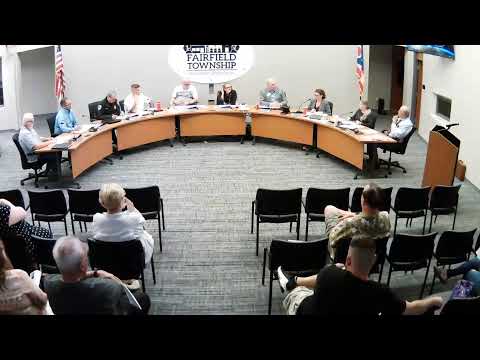
Fairfield Township trustees held a public hearing Tuesday on the proposed fiscal year 2026 tax budget, which projects $19,828,498 in revenue and $23,242,824 in expenditures.
Fairfield Township trustees held a public hearing Tuesday on the proposed fiscal year 2026 tax budget, during which staff outlined a draft that projects $19,828,498 in total revenues and $23,242,824 in total expenditures, leaving a projected fund balance of $6,779,113.54.
The draft budget presentation emphasized that most township money is held in designated “funds” that can be spent only for their statutory purposes. “Every fund is separate and individual, and we can only use for those purposes,” the presenter said, explaining why revenues are shown by fund and why transfers between funds may be required.
Why it matters: the budget shows the township planning to spend more than it projects to take in in 2026 and anticipates transfers from the general fund to make up shortfalls in the police, fire and public works funds. Trustees and staff said the hearing is a required step in the appropriation process and that listing an item in the appropriations does not itself obligate the township to spend the money.
Key details from the draft
- Total projected revenue: $19,828,498; total projected expenditures: $23,242,824; projected overall balance shown $6,779,113.54. - The presenter detailed many special revenue and project funds: motor vehicle license tax, gasoline tax, road and bridge fund, permissive motor vehicle license tax, lighting district, JED (joint economic development) receipts, sewer TIP, Princeton Road TIP and several capital-project and opioid-settlement (OneOhio) funds. - Examples from the presentation: the road and bridge fund was discussed as the main source for public works personnel costs; the fire fund revenue projection was listed at $5,045,640 with expenditures of $4,046,140; the police fund revenue projection was $3,078,912 with expenditures of $2,368,080. - The presenter said many funds are ‘‘special revenue funds’’ and cannot be commingled for other uses; the general fund is the principal flexible fund for administration and may be used for transfers.
Public and trustee questions
Members of the public asked for clarification about “inside” (nonvoted) millage. Resident Richard Wheeler asked, “When you talk about the tax, then what we're nonvoted in this issue, what does nonvoted mean?” A trustee responded: “It's an amount we're allowed to assess without the voters called inside millage. ... It's ORC.”
Trustees and staff also discussed prior one‑time sources used in recent years: staff said the township received ARPA and CARES funds in earlier years and that those receipts (some of which were spent in later fiscal years) affected recent year-to-year comparisons. Staff noted ARPA receipts in 2025 totaled about $150,000.
Process and next steps
Trustees moved to open and later to close the statutorily required public hearing during the June 17 meeting; both motions passed by roll call. Several trustees said they prefer returning to the topic at another meeting before taking final appropriation or levy action. A trustee noted the board historically does the public hearing and resolution in the same meeting but acknowledged the board can adopt a resolution at a later meeting and must meet statutory certification deadlines if they pursue levies.
No appropriation or final budget resolution was adopted at the June 17 meeting; staff said copies of the proposed budget are available in the township office and that trustees expect to consider final action at a subsequent meeting.
Ending
Trustees closed the hearing and moved to additional agenda items. Staff and trustees said they will bring clarifications and potential adjustments back to the board prior to any formal appropriation or levy certification.