Get Full Government Meeting Transcripts, Videos, & Alerts Forever!
Get email alerts on the Municipal Collections topic
No spam. Unsubscribe anytime.
General Government Committee presses to resolve unpaid ordinance tickets; OpenGov rollout and repeat violator enforcement highlighted
Summary
Springfield City officials discussed a backlog of unpaid ordinance tickets, progress moving enforcement records into OpenGov so they can be attached to tax bills, and enforcement options for repeat violators including a Dollar Tree location with roughly $1,450 in unpaid fines.
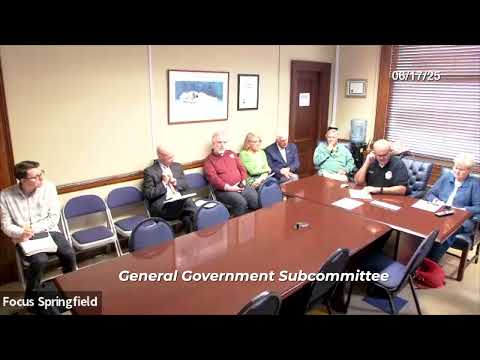
The Springfield City General Government Committee on Tuesday discussed a longstanding backlog of unpaid ordinance tickets, steps to consolidate enforcement records into a single software system, and possible enforcement actions against repeat violators.
Committee Chair (unnamed) opened the meeting by saying, “we're gonna be discussing, unpaid ordinance tickets.” The discussion focused on how unpaid municipal citations are tracked, when they can be attached to property tax bills, and how the city can respond to businesses and properties with repeated violations.
Committee members and staff said the city has been working with multiple legacy systems. Steve (Acting Controller) described the current collection process: when fines are unpaid they can be converted to a municipal lien certificate and included on the third-quarter tax bill after department review. He said the city “averages about $200,000 a year” in amounts placed on tax bills and budgets roughly $50,000 annually to file liens.
Police liaison Suhely Yarsi provided a specific local example: the Dollar Tree on Ward 7 has seven unpaid violations and six paid violations spanning 2023–2025, and "there's still $1,450 that are currently owed," with officers increasingly issuing $300 citations at that location since February 2024. Council members described recurring litter and cleanliness problems at that parcel and asked what additional enforcement tools the city can use beyond repeated fines.
Solicitor Thomas Moore and other legal staff said the city has civil enforcement tools, including housing-court-style orders and municipal lien certificates, and that in some cases the city can pursue court orders compelling cleanup or seek contempt remedies if orders are ignored. Moore said criminal prosecution is rarely used for these quality-of-life violations and noted practical limits when trying to pursue criminal charges against a business entity rather than an individual manager.
City staff and IT representatives described an ongoing project to migrate ordinance-violation records from older systems (Acela, Code B) into OpenGov, which will integrate with Munis (the city’s finance system) so enforceable charges tied to properties can be placed on tax bills. IT staff James Regolo said, "we're going live by the thirtieth," and Chief Information Officer Andy Doty and others said departments are prioritizing police, code enforcement and health for the first phase. Staff estimated the OpenGov–Munis integration should be completed in June and committed to a follow-up status report to the committee in 60 days.
Committee members asked about transparency and public pressure tools used elsewhere, such as publishing chronic nonpayers' names or photographs on a city site or in local papers to improve collections. Legal staff advised that publication is limited by statute and that publishing costs are generally not recoverable as part of the debt; staff said the city can explore posting information on the city website but will need to confirm legal constraints and publishing procedures.
Committee Chair summarized next steps: (1) IT and departments will accelerate the OpenGov migration so police, code and health violations appear in a single view that feeds Munis; (2) staff will provide the committee a consolidated accounting of outstanding ordinance-related receivables after the migration and a status report in roughly 60 days; and (3) legal and code enforcement staff will evaluate escalating enforcement for repeat violators (including court filings seeking orders to clean up property or other civil remedies).
No formal votes or ordinance adoptions were recorded during the meeting.
The committee scheduled follow-up reporting and asked staff to return with details on outstanding balances citywide once OpenGov–Munis integration is live.