Get Full Government Meeting Transcripts, Videos, & Alerts Forever!
Get email alerts on the Sewer Service topic
No spam. Unsubscribe anytime.
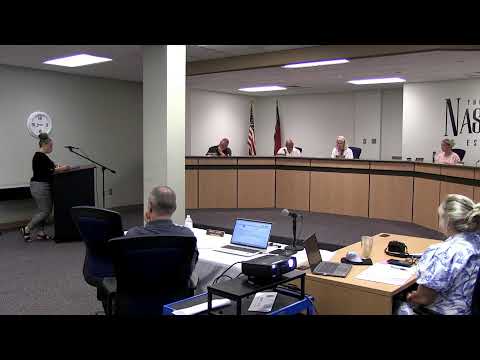
Nashville council approves 40-year sewer service agreement with Rocky Mount, raises daily allotment to 1,000,000 gallons
Summary
The Nashville Town Council approved a 40-year renewal with the City of Rocky Mount to treat town wastewater, increasing the average daily volume allotment from 775,000 to 1,000,000 gallons and adding language for metering during heavy-rain surcharging events.
The Nashville Town Council voted to approve Resolution 2025-19, a new 40-year sewer service agreement with the City of Rocky Mount that raises the town’s permitted average daily discharge to Rocky Mount from 775,000 gallons to 1,000,000 gallons and includes new language addressing metering during heavy-rain “surcharging” events.
The change matters because Nashville’s historical average flows have exceeded the previous contract limit in most of the seven years shown in the packet. Under the new agreement, when the Old Carriage Road meter vault floods and the meter stops recording, the town and Rocky Mount will assume a flow rate of 2.19 cubic feet per second from the time the meter goes underwater until readings resume. The contract renews automatically in 10-year increments up to four times and may be amended by mutual agreement with 60 days’ advance notice; annual sewer charges are set by Rocky Mount and applied to Nashville’s bills.
Council members and staff said the increase reflects recent growth and their work to reduce infiltration and inflow (I&I) in the town’s system. Staff described ongoing I&I mitigation: sealing manholes with CTR coatings funded by a Nash County grant, televising mains to identify leaks, and a planned $78,000 package to clean and televise selected lines and decide whether to slip-line them. Staff also said many service lines (the privately owned lines from houses to mains) can be sources of I&I but that property owners typically own and would be responsible for those repairs.
Council members asked whether Rocky Mount has historically charged Nashville for exceeding the contract allotment. Staff said Rocky Mount had not charged the town in the seven years the packet reviewed, but the new contract includes language about charges and staff recommended keeping the increased allotment while monitoring volumes and requesting increases if the town approaches the limit.
Council and staff discussed alternatives to continued reliance on Rocky Mount for treatment. Staff said drilling and owning water wells is generally less expensive for water supply but that building and operating a new wastewater treatment plant would face permitting challenges because the North Carolina Department of Environmental Quality has favored regionalization and typically will not permit small, stand-alone treatment plants when a regional option exists. Staff also noted that Atlantic Natural Foods is no longer operating; that reduces the town’s previous exposure to industrial surcharges for biochemical thresholds.
Council approved the resolution after discussion and a motion to proceed, with the mayor announcing the motion carried.
Details recorded in the packet include the prior limit (775,000 gallons per day), the new limit (1,000,000 gallons per day), the assumed flow rate during metering outages (2.19 cubic feet per second), the current published sewer unit charge noted in the packet ($5.18 per 748 gallons as converted from cubic feet), and the automatic renewal and amendment terms.