Get Full Government Meeting Transcripts, Videos, & Alerts Forever!
Get email alerts on the Land Use Subdivision topic
No spam. Unsubscribe anytime.
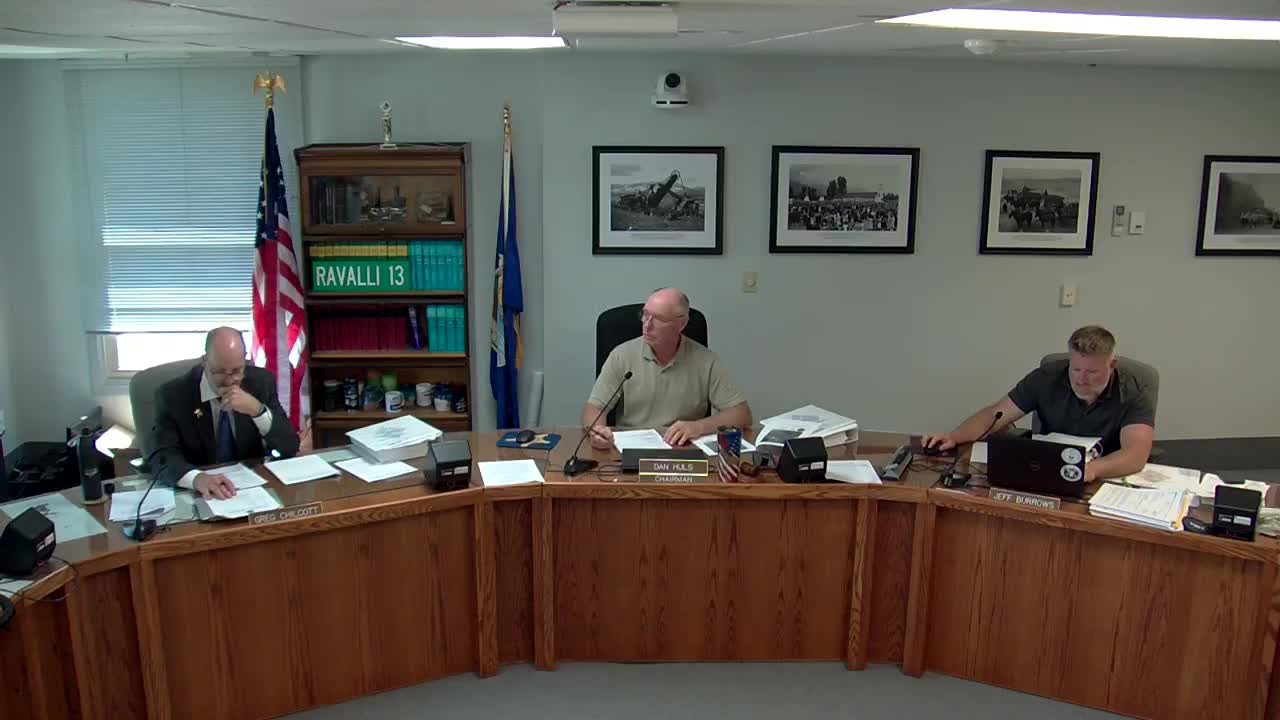
Ravalli commissioners continue High Post Acres 5‑lot subdivision hearing amid water, road concerns
Summary
The Board of County Commissioners agreed to continue the High Post Acres 5‑lot minor subdivision hearing up to 30 days after questions from commissioners and adjacent landowners about groundwater impacts, roadway maintenance and culvert installation.
Ravalli County commissioners on June 9 continued a public hearing on the proposed High Post Acres five‑lot minor subdivision after hearing detailed staff analysis and questions from neighbors and commissioners about water availability, road maintenance and drainage.
Planning staff reviewed the application for a five‑lot subdivision on roughly 24.6 acres east of Florence off Aspen Ridge Trail and recommended conditional approval subject to standard final‑plat conditions and mitigation measures. Rob (Planning staff) told the commission the application included a hydrogeologic summary that relied on an earlier 2007 aquifer study for the adjacent Saddle Hills/ Aspen Ridge area and that the Montana Department of Environmental Quality (DEQ) had outstanding technical questions mainly about stormwater pond sizing.
The matter drew sustained comment from neighboring property owners and the applicant. Elizabeth Bando submitted written comments asking about notice, a maintenance agreement for shared roadway, whether covenants would mirror existing neighborhood CC&Rs, timing and installation of a culvert and guarantees on repair of road damage from construction equipment. Edward Adkins of Bridal Estate Services, representing the adjacent Aspen Ridge/Saddle Hills development, said his clients were concerned about well interference and asked for a formal agreement to address road maintenance and repair.
Developer representative Dan Schneider told the board he and his partners intend to limit lawn irrigation in the covenants and restrict water use, and stressed the financial constraints on small landowners. "The 1 curveball that we were pitched was Pro Rata Road share. And that impact fee is significant," Schneider said, adding the project was intended for family members rather than speculative development.
Commissioner Burrows pressed consultants and staff for a clearer, quantitative link between the 2007 hydrogeologic study and the proposed five exempt wells for this subdivision, asking whether the prior study — which included multi‑well pump tests and observation wells nearby — reliably demonstrates no significant drawdown to neighbors if additional exempt wells are drilled. Consulting engineer/attorney Dan Fulton (IMEG Corp., representing the applicant) and others explained that the existing study and local well logs support the conclusion that wells in the area can produce in the DEQ customary range (roughly 5–10 gallons per minute in long‑duration tests) and that proposed well locations had been spaced to reduce interference, but they acknowledged the limits of the prior study for predicting cumulative, long‑term regional impacts.
Road and stormwater topics also drew substantive discussion. Planning staff noted the subdivision road, a cul‑de‑sac and a proposed culvert are on the submitted plans and recommended a condition that the small irregularity in a roadway easement on Lot 5 be resolved by expanding the easement to the lot boundary or by a variance. Bitterroot Disposal (solid waste) has been consulted; staff and the applicant said curbside pickup options are being explored but that a community collection point currently serves the area.
After discussion the commission voted to grant the applicant a continuance of up to 30 calendar days to allow the applicant and consultant to provide supplemental information and for staff to coordinate scheduling; the parties agreed to aim for a July 9 hearing date or an earlier available date. The commission instructed planning staff to notify commenters and interested parties of the continued hearing date when scheduled.
Discussion only: no final subdivision approval was made at the June 9 session. The record shows the applicant must still resolve final plat requirements, address the DEQ comment on stormwater sizing, and provide final utility easements and final plat submittals if the hearing is resumed.
What happens next: the applicant and consultant will try to arrange supplemental technical testimony (the applicant identified a hydrogeologist who authored the 2007 study and indicated he is available to provide additional explanation) and will coordinate with planning staff on a continued hearing date within the 30‑day extension.