
Council debates use of unspent CDBG funds for fire vehicles and turnout gear; asks for audit and clearer reporting
Get AI-powered insights, summaries, and transcripts
Subscribe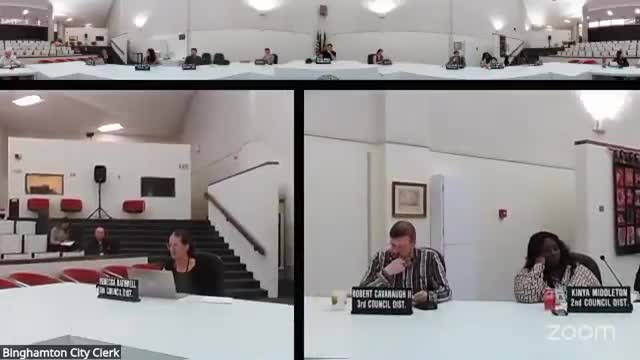
Summary
The Binghamton City Council heard a request to reallocate unspent CDBG funds to buy one med vehicle, one hazmat/utility truck and turnout gear for firefighters. Several council members pressed city staff for a full accounting of unspent federal grants and a regular reporting schedule before approving transfers.
Binghamton City Council members questioned a midyear request to move unspent Community Development Block Grant (CDBG) dollars to buy 1 medic vehicle, 1 hazmat/utility vehicle and additional firefighter turnout gear, pressing city staff for a full audit and clearer, recurring reports on unspent federal grant funds.
The funding request, presented at the June 16 work session by Deputy Mayor Megan Hyman and Fire Chief Al Gardner, would amend the city's FY50 CDBG action plan to transfer older, unspent grant allocations toward capital equipment for the Binghamton Fire Department. Hyman said the two vehicles would help firefighter-paramedics respond to citywide medical calls and that turnout gear must be replaced according to national standards; Chief Gardner said the department needs a 1-ton utility for towing hazmat and foam trailers and a one-ton pickup to serve as a medic response vehicle.
Council members focused less on the fire technical needs than on the source and oversight of the money. Council member Murray and others said the council has repeatedly been told that isolating an exact unspent balance is complicated and that, in practice, older allocations have gone unspent for years. Murray asked for a full audit of unspent CDBG, HOME, ESG and COVID-related dollars dating back to fiscal years referenced in the packet (items as far back as fiscal year 44 were discussed) and said she would not support moving forward on reallocation requests until that accounting is delivered. Hyman and budget staff said unspent amounts fluctuate as agencies draw down allocations, but that staff can provide point-in-time snapshots and work with auditors to identify stalled projects.
Council members asked for more detail about specific lines in the packet: about $357,685 in identified unspent CDBG funds was discussed during the meeting; about $145,000 was noted in a contractual services line (described in the packet as related to older budget years), and roughly $49,579 was identified as an auditing/financial services salary line. Staff said the contractual entries include legacy salary allocations and that HUD's updated guidance on what salary costs are eligible changed some prior assumptions.
Council members also raised programmatic limits tied to federal rules. Hyman reiterated that the city is near the 15% cap on public-service spending and that the present request was for capital purchases (vehicles and equipment) that do not count against that cap. The deputy mayor and staff said some vehicle replacements followed unexpected events (an officer's vehicle totaled in a crash and an older hazmat van reaching the end of service life), and that some of the turnout-gear need stems from changing operational best practices and increased attention to carcinogen exposure.
Multiple council members asked whether grant funding (for example, Assistance to Firefighters Grant, AFG) had been sought. Chief Gardner said SCBA replacement was previously funded by a federal assistance grant and that vehicle grants are difficult to obtain; turnout-gear funding has in the past come from a mix of state or federal programs but is less reliable now. Hyman and staff said they work with agencies and auditors to find older allocations that appear unlikely to be spent, and then reallocate those funds using the action-plan amendment process when appropriate.
No formal council vote on the CDBG amendment occurred during the work session. Instead, council members made two explicit requests of staff: (1) a full audit and line-by-line accounting of unspent CDBG, HOME, ESG and COVID-era funds (including historical allocations back to the years mentioned in the packet), and (2) a recurring status report on allocations and spend-downs (council suggested at least quarterly; staff offered to provide a point-in-time snapshot annually and discussed a possible four-month reporting cadence). Steve Carson, who will present the FY51 budget, was identified as the staff member who would provide more detailed accounting and to whom council directed follow-up questions.
Council members said the requested audit and improved communication are intended to give the legislative branch sufficient information to evaluate midyear reallocations. Hyman and Carson said they would work with council to deliver clearer documentation and to bring detailed figures to committee and future work sessions.
The council's discussion also touched on broader FY51 Consolidated Plan and CDAC funding questions: the mayor's budget package includes a $25,000 minimum grant threshold (adopted administratively this year), which altered how some CDAC (Community Development Advisory Committee) recommendations were carried forward in the mayor's proposal. Council members asked staff to produce a comparison of CDAC recommendations and the mayor's proposed budget and to explain why specific projects were shifted or re-prioritized.
Council members emphasized a desire for transparency: when staff learn funds are unlikely to be spent by recipient agencies, council expects to be notified promptly so the legislative branch can consider alternative uses without surprise mid-meeting reallocations.
Next steps included staff commitments to provide the requested audited accounting and a point-in-time report on unspent allocations, and to return with more detailed answers to council questions about HUD eligibility, service caps and the mayor's changes to CDAC recommendations. No transfers were finalized at the June 16 work session.