Get Full Government Meeting Transcripts, Videos, & Alerts Forever!
Get email alerts on the Housing Eviction Policy topic
No spam. Unsubscribe anytime.
Local advocate urges Schenectady to opt into state good-cause eviction law, cites high eviction filing rates
Summary
At the May 27 meeting, an advocate urged the council to adopt New York’s good-cause eviction protections for municipalities outside New York City, citing 2022 eviction filing rates that he said are far higher in some Schenectady ZIP codes than neighboring communities.
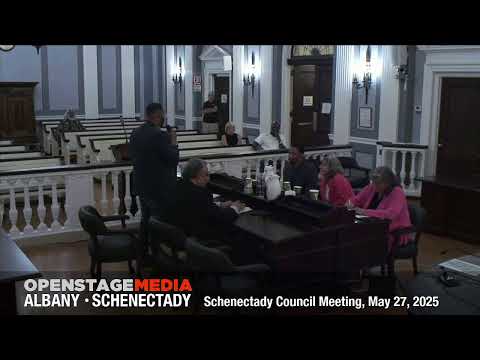
Colin McNamara told the Schenectady City Council on May 27 that the city should opt into the state’s good-cause eviction law and cited eviction-filing rates for several local ZIP codes to argue the measure would protect households at elevated risk of displacement.
“Over in Hamilton Hill, the 12307 zip code, there is 1 eviction filing for every 6.8 households in that area,” McNamara said, and he cited other ZIP-code comparisons from 2022 for Scotia, Schenectady and the Stockade area. He described the state law as an opt-in system for municipalities outside New York City and said advocates had hoped for an opt-out default but the enacted law requires local action to take effect.
McNamara framed the law as aimed at preventing evictions “for no cause whatsoever” and said it would not eliminate all evictions but would stop many that advocates consider unnecessary. He said the law could reduce shelter stays among households with children and urged the council to consider adopting the protections.
Why it matters: McNamara presented eviction statistics and framed good-cause eviction as a municipal policy tool to limit certain landlord-initiated evictions. The council did not take formal action on his remarks during the public-comment period.
Details from remarks: McNamara said his ZIP-code figures come from 2022 data and noted demographic context—higher renter shares, larger shares of households with children and single-parent households—in the ZIP codes he cited. He said the law allows municipalities to decide whether to adopt protections for tenants outside New York City.
No council vote or motion was recorded on the topic in the meeting transcript.