Get Full Government Meeting Transcripts, Videos, & Alerts Forever!
Get email alerts on the Dpw Budget Fy2026 topic
No spam. Unsubscribe anytime.
Guam public works seeks $22.4 million for FY2026; lawmakers press agency on staffing, village paving and abandoned vehicles
Summary
At a June 19 public hearing on Bill 44-38 COR, Department of Public Works officials presented a $22.4 million FY2026 budget request and answered senators’ questions about hiring, village streets paving, abandoned-vehicle removal, electric school-bus grants and efforts to speed permitting.
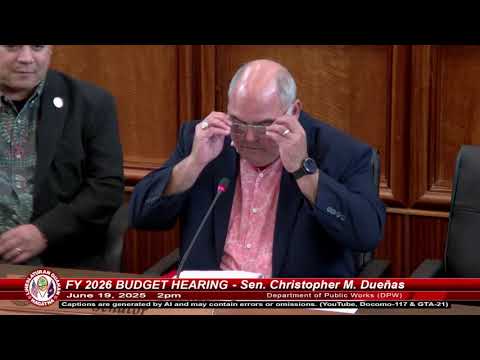
The Guam Legislature’s Committee on Finance and Government Operations on June 19 heard testimony on Bill 44-38 COR, the governor’s proposed appropriations measure that would fund the Department of Public Works’ (DPW) operations for fiscal year 2026. DPW Director Vince Areola told the committee the department’s total requested budget is $22.4 million, an increase of just under $500,000 from the prior year.
Why it matters: The hearing focused on whether DPW has the staff and procurement capacity to spend appropriated funds and deliver projects islandwide — from village-street paving to school-bus operations and stormwater work — and on how DPW will manage federal grants that require matching work or follow-up. Senators pressed DPW on recruitment and retention for technical trades, timelines for village paving and road repairs, and the logistics of abandoned-vehicle removal now assigned to DPW by law.
In his opening, Areola summarized DPW’s budget by major object class and outlined priorities across divisions. "DPW’s total budget request amounts to $22,400,000, an increase of just under $500,000 from last fiscal year," Areola said, citing salary and benefits as the largest share. He reported roughly $16 million in salaries and benefits, contractual services of about $3.2 million (including road paving), equipment at about $82,000 and capital outlay near $410,000.
Areola said DPW relies on two main funding sources for operations: the Territorial Educational Facilities Fund (TEF) — which funds bus operations — and the Guam Highway Fund, with supplemental general-fund support for other divisions. He told the committee DPW currently manages about 47 active capital improvement projects with a combined cost of roughly $93.6 million and highlighted several large projects including the Hagåtña swimming-pool renovation, a new bio-laboratory near the University of Guam, and a $4.2 million Guam Police Department evidence building.
Senators questioned DPW on near-term deliverables and capacity. Committee Chair Senator Christopher Duenas and Vice Speaker Tony Atta asked about the department’s ability to execute village-street paving. Areola said task orders are already out on much of the $3.5 million village-streets balance and listed recent and planned village work (Agat, Yona/Umatac areas, Malesso, portions of northbound work) but acknowledged the balance is largely committed through encumbrances. He said DPW will seek supplemental funding for additional work and noted that mayors help prioritize which village streets are scheduled.
Staffing, recruitment and pay were recurring concerns. Areola described difficulty recruiting engineers, certified trades and mechanics under current salary structures and said DPW will request a salary assessment from the Department of Administration. "The labor field on Guam for technical personnel is very competitive," he said, listing engineers, planners, electricians, A/C technicians and plumbers as especially hard to hire. Senators told DPW they want fast action on salary adjustments; Areola said he will pursue a formal salary study and work with DOA and, if necessary, return to the Legislature with proposals.
Abandoned vehicles and related cleanup work drew detailed questioning. Areola described implementation of Public Law 37-60, which assigned collection of abandoned vehicles to DPW, and said DPW is negotiating a memorandum of understanding with the Environmental Protection Agency to secure funding that previously went to mayors. "Despite that, we've been able to still pick up cars. We've collected over 150 vehicles," Areola said, adding that vehicle removal diverts crews from routine road maintenance and creates public-safety hazards if left in place.
Bus operations and school transportation were another focus. Areola reiterated that bus operations are funded through TEF and that DPW’s bus budget request was about $7.9 million. He said DPW requires more stringent oversight of drivers, random drug testing and improved pretrip supervision; DPW also plans to rebid a previously protested procurement for electric school buses and corresponding charging infrastructure after confirming federal grant availability. On electric buses, Areola said federal funds are still available but that DPW must refine charging-station cost estimates and coordinate with Guam Power Authority. Senators pressed whether DPW has the maintenance capacity for electric bus technology; Areola said bus supervisors remain cautious and DPW will discuss feasibility with the federal grantor in an upcoming meeting.
Permitting delays and a stalled digital "one-stop" permitting portal also surfaced. Areola said DPW has used pre-application reviews for larger projects to reduce turnaround times but that reviews elsewhere (notably EPA and island agencies with environmental or endangered-species checks) often drive delays. He confirmed a procurement protest forced rebidding of the digital-permitting contract and that DPW recently received direction to rebid.
Office of Highway Safety work and federally funded grants were discussed as well. Areola said the office is 100% federally funded, performs community outreach and data-driven traffic safety programs, and that DPW is pursuing federal RAISE and FHWA grants for safety and Route 10/Route 14 improvements. He flagged a planned mill-and-pave of Route 10 safety improvements and noted an ongoing federal-backed traffic-signal replacement project that was damaged by Typhoon Mawar.
Committee members also pressed DPW about specific local issues: bus-shelter replacements (Areola said DPW plans to build 30 shelters this year at roughly $2,000–$2,500 in materials per shelter when built in-house), replacement of traffic signs (a procurement to replace more than 1,800 signs damaged in the typhoon is underway using a federal emergency grant), and maintenance of government buildings including work needed at the Office of Homeland Security/EMC (a new work request was submitted to address deficiencies).
The hearing produced no vote. The committee said it will accept written testimony on Bill 44-38 COR for seven calendar days following the hearing.
What’s next: DPW requested a formal salary assessment from DOA, plans to rebid the digital-permitting contract and the electric-bus procurement, and expects to continue pursuing federal grants. Senators signaled willingness to consider supplemental appropriations for village paving if DPW provides staged project lists and procurement-ready scopes.