Get Full Government Meeting Transcripts, Videos, & Alerts Forever!
Get email alerts on the Climate Planning topic
No spam. Unsubscribe anytime.
Spokane board finalizes Phase 1 climate assessment, outlines Phase 2 priorities and engagement
Summary
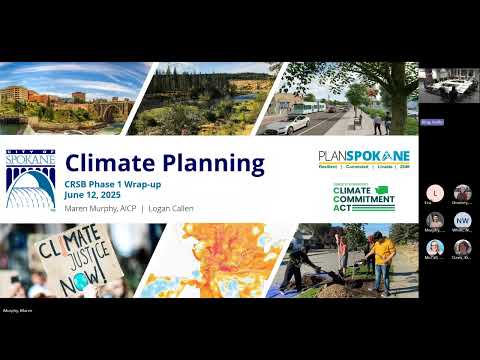
Spokane staff briefed the Climate Resilience and Sustainability Board on the close of Phase 1 of the city’s climate-planning grant and outlined a multi-month Phase 2 process that will develop draft goals, policies and a prioritization framework for the city’s comprehensive plan.
Spokane staff briefed the Climate Resilience and Sustainability Board on the close of Phase 1 of the city’s climate-planning grant and outlined a multi-month Phase 2 process that will develop draft goals, policies and a prioritization framework for the city’s comprehensive plan.
Phase 1 deliverables due to Washington State Commerce in early July include a climate impacts and climate justice memo, a city climate policy audit, an online climate vulnerability index and a draft climate risk and vulnerability assessment (CRVA). Marlene Murphy, the project lead, told the board “all of our materials [are] due in the next couple of days. Commerce is on the state biennium, so their deadline for all of their work as well is June 30.”
The Phase 1 work package was intended to compile facts and community feedback to ground policy choices. Murphy said the team reviewed roughly 1,200 existing policies and produced an audit to identify gaps and opportunities to align the comprehensive plan and other city strategies. She described the climate vulnerability index as “an online platform that allows people to look at different indicators” and said an executive summary and appendices will accompany the full CRVA when it is posted.
Board members and staff described several strands of community engagement woven into Phase 1: a technical advisory committee, tribal engagement, neighborhood council workshops, an early planning survey, an Earth Day workshop and focused small-group meetings for youth, northeast Spokane residents and climate-justice–oriented organizations. Murphy said the CRVA will include callout boxes showing specific input from those engagements.
Several board members emphasized equity, education and workforce development as priorities going into Phase 2. Catherine Alexander asked how focus-group participants were recruited; staff said invitations used partner organizations, school-district contacts for youth, neighborhood centers for geographically focused groups and lists of local nonprofits for climate-justice participants. Kevin Fagan recommended workforce and tree-equity work already underway at the state level as examples the city could study; he said Washington DNR and American Forests have programs and statewide collaborations that may inform local green-job training.
Phase 2, the board was told, will run over the coming six to eight months and will produce draft goals and policies that must do at least four things described in Commerce guidance cited in the meeting: support greenhouse-gas reductions, foster climate resilience, prioritize overburdened communities and advance environmental justice. Staff said they intend to run a multi-criteria prioritization analysis that will weigh effectiveness, co-benefits, timeline, equity, feasibility, cost and legal authority — and that commerce will recommend emphasis on measures the city has jurisdiction to implement.
Board members pressed staff on sequencing and community input points. Staff said a summer survey will seek community preferences on priorities and trade-offs (for example, whether feasibility or cost should weigh more heavily), to inform topical focus groups and district workshops in the fall before integrating prioritized policies into the comprehensive-plan update. Murphy said the City is applying for additional legislative funding (a legislative appropriation) and that continuation into Phase 2 is expected but contingent on that appropriation.
Participants also raised substantive topics for Phase 2 work: stronger tribal and cultural-resource protections; more explicit measures for climate education (especially for youth); tree equity and urban-forestry workforce programs; and measures to improve language access and data disaggregation to identify disproportionate impacts. Board members also flagged soil health and rainwater retention as technical topics they want folded into risk-reduction and nature-based solutions discussions.
No formal policy was adopted at the meeting. Board members were asked to expect ongoing, detailed policy conversations in future meetings and to provide input on survey and focus-group design before staff launches Phase 2.