Get Full Government Meeting Transcripts, Videos, & Alerts Forever!
Get email alerts on the Youth Program Funding topic
No spam. Unsubscribe anytime.
Council weighs Belmont Pop Warner funding, asks staff to map available youth-budget lines
Summary
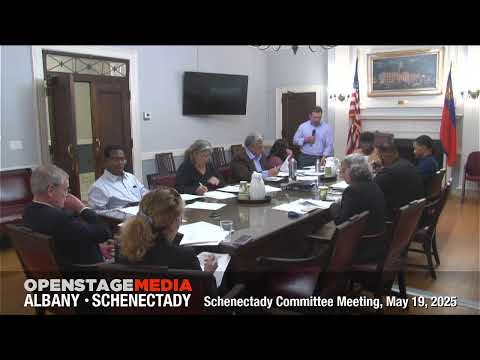
Schenectady council members discussed a $47,000 funding request from Belmont Pop Warner on May 19 and asked staff to return in two weeks with details on available ARPA and other city youth-program lines; no appropriation was made at the meeting.
Schenectady City Council members on the Finance Committee debated whether to provide $47,000 in city support to Belmont Pop Warner after the organization asked the city to cover regular-season costs for its upcoming season.
The conversation focused on funding sources and equity across youth programs; council members asked staff to report back with how much remains in two budget lines — a $150,000 youth-services line and a $109,000 Coco House line — and whether public-safety or other resources could help cover some costs. No appropriation was authorized; the committee requested a report back in two weeks.
The request was presented to the committee as a single-season ask of $47,000. Council members clarified that the program’s postseason expenses were listed separately (about $30,000) and said the current request was for the regular season. “I’m looking for us to fund this — fully fund the program,” Council Member Farley said during the discussion, emphasizing the program’s history of serving city youth and asserting that the league has operated for decades with limited institutional support.
Other council members supported the program’s value but pushed for a measured, citywide approach. Council Member Otero and others pressed for parity, noting other grassroots youth programs also seek help and asking whether the city should devise an inclusive policy rather than fund a single organization on an ad hoc basis. Parks and recreation staff were asked to clarify whether Belmont uses city park fields (Farley said practices occur on a city-owned field behind Mount Pleasant Football Field and games use some school facilities) and whether the youth program has sought school-district funding.
Parks and recreation director Maseca (title given during the meeting) and staff member Michael agreed to research prior funding sources, whether Belmont had sought school support, and the remaining balances in the youth-related lines. Committee members also noted a possible $50,000 public-safety/community-engagement allocation that might be available to offset costs.
Committee members discussed longer-term budget planning as well as a mid-cycle response. Several said they would prefer a 2026 budget discussion to set a recurring city approach to programmatic youth support — distinguishing capital investments in fields from programmatic operating support such as uniforms, travel and equipment.
The committee’s agreed next step was not an immediate vote but a staff report: finance and parks staff will return with the available balances for the $150,000 youth line and the $109,000 Coco House line, details on prior funding sources for Belmont, and whether the group has sought school-district support. The committee indicated it intends to consider a formal vote when that information is available, aiming to do so within roughly two weeks.