Get Full Government Meeting Transcripts, Videos, & Alerts Forever!
Get email alerts on the Comprehensive Plan Public Participation topic
No spam. Unsubscribe anytime.
Ashland County planning committee adopts public participation plan for comprehensive update
Summary
The Ashland County Planning Committee voted to adopt a public participation plan to guide its 10‑year comprehensive plan update, approving a baseline approach while preserving the right to reconsider the document at the committee's next meeting.
The Ashland County Planning Committee voted June 17 to adopt a public participation plan intended to guide public outreach for the county's comprehensive plan update.
The committee adopted the plan with a motion from George Boussay, who moved to approve the clean copy of the public participation plan, and a second; the motion carried by voice vote. "I would make that motion to approve the clean copy of the public participation plan," Boussay said during the meeting. The committee recorded no public comments before the vote.
The plan fulfills the statutory requirement that a local unit of government adopt written procedures to foster public participation during the comprehensive plan update, committee members said. "The timeline that Northwest Regional sent us said that we should have a plan in place this month," said Erica (staff member), citing the regional planner's recommended schedule and the committee's need to meet a near‑term deadline for having a public participation plan in place.
Why it matters: Under Wisconsin law the governing body must adopt procedures for public participation during each stage of a comprehensive plan update; the committee's vote provides a working baseline so the county can move forward with work by Northwest Regional Planning and other contractors. Committee members repeatedly emphasized that the adopted document is a baseline and that they expect to refine details — including email addresses, specific outreach tools, and meeting timing — before final publication.
What the plan does and what remains unresolved - The plan lays out staged steps for data collection, issue identification, goals and objectives, strategy development and a public hearing at the end of the process. Committee members and staff described it as a guidance checklist rather than a rigid schedule. - The committee approved the clean copy but preserved the right for those who voted in favor to move for reconsideration at the next meeting. "If we vote to approve this, we're voting to approve the clean copy," the chair said; members noted a marked‑up and clean copy were both present in the packet. - Members pressed for clarity on the number and format of public meetings. Some members said the seven meeting framework in the plan could translate into many more public events if each stage required separate meetings; others said Northwest Regional Planning typically recommends a steering‑committee schedule and that many items can be grouped together.
Tribal and jurisdictional limits: committee members spent significant time clarifying how the county's planning work would treat tribal lands and cultural sites. Mary Jo (staff member) explained that the agriculture, cultural and natural resources section is a descriptive element of the comprehensive plan that should identify significant places countywide, including tribal cultural sites, without asserting county authority over sovereign tribal lands. "The Bad River Band of Chippewa would fall into that as a cultural site," Mary Jo said, adding that goals and activities for tribal lands would only be listed if done in collaboration.
Next steps and timeline: Northwest Regional Planning remains the intended consultant but cannot bill the county until a signed contract is in place; staff said the CDBG (Community Development Block Grant) pre‑agreement and several administrative steps are still in process. Staff reported Northwest Regional Planning's schedule anticipates a first steering committee meeting in August (month 4 of the consultant timeline), but the exact start date depends on finalizing the contract and grant paperwork.
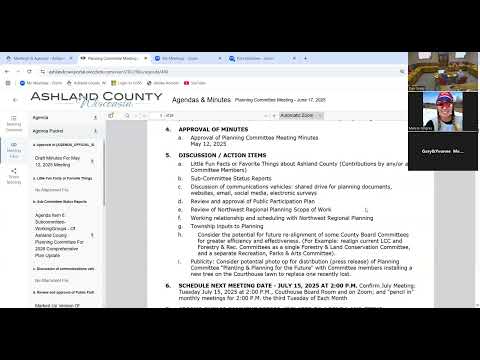
Votes at a glance: the committee recorded three formal procedural approvals during the meeting: approval of the meeting agenda (motion by Brad Ray, second Pat Kinney; outcome: approved), approval of the May 12 minutes (motion by Liz Franek, second Brad Ray; outcome: approved), and adoption of the public participation plan (motion by George Boussay; second not specified on the record; outcome: approved). For the participation plan the committee explicitly allowed members who voted in favor to move for reconsideration at the next meeting.
Committee comments and safeguards: several members urged caution that the participation plan remain flexible. Committee member Brad Ray and others asked that the staged sequence not be interpreted as mandatory if practical scheduling or staff capacity requires combining events; staff said the document itself notes it is adaptable. Erica recommended that when the plan is revised staff insert concrete contact information (final email or postal address) in the clean copy before final publication.
What the vote does not do: The committee's action adopts a public participation procedure for the comprehensive plan process at the committee level; it does not finalize the comprehensive plan itself. The committee and staff repeatedly emphasized that final review and a public hearing will be required later in the update process, including the 30‑day public notice that state law requires for the final public hearing.
Ending note: Committee members asked staff to invite Northwest Regional Planning to the next meeting for direct discussion of schedule and meeting design. The committee also directed staff to make modest technical adjustments — such as clarifying the public contact email — before public distribution of outreach materials.