Get Full Government Meeting Transcripts, Videos, & Alerts Forever!
Get email alerts on the Workforce And Program Capacity topic
No spam. Unsubscribe anytime.
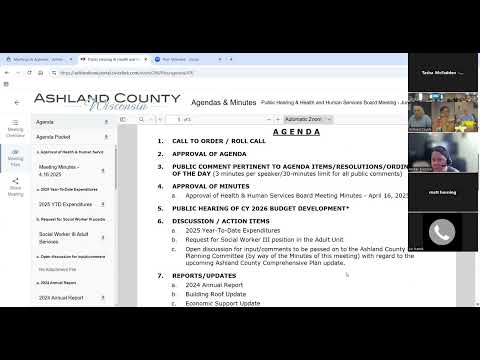
Committee forwards request to add Social Worker 3 to handle growing CLTS caseload
Summary
The Ashland County Health and Human Services Committee voted to forward a request to the executive committee to fill a Social Worker 3 position to provide mid‑level supervision and authorization processing for the Children’s Long Term Support (CLTS) program after staff described rapid caseload growth and administrative bottlenecks.
The Ashland County Health and Human Services Committee voted to forward a request to the executive committee to fill a Social Worker 3 position intended to supervise the Children’s Long Term Support (CLTS) caseload and handle prior authorizations that staff say have become a bottleneck.
Committee members were told the CLTS program has grown “exponentially” since it became effectively an unofficial entitlement and now generates frequent prior‑authorization requests that require specialized review. Tasha, identified in the meeting as the ADRC branch manager, said the volume of authorizations and supervisory work has become “way too much” for her alongside her other responsibilities and that a mid‑level supervisor would both carry cases and take over entering and submitting authorizations to the state, saving time for fiscal staff and case managers.
Supporters said the new role would be at a higher pay grade than a regular case manager, would not be exempt/salaried, and could have a portion of its costs recovered through the county’s Medicaid reconciliation process. The committee discussed budgetary impacts and billing mechanisms; one member asked for clarification about whether the hiring would affect the county budget. Staff replied that much of the position’s expense should be captured via the Wisconsin Medicaid reconciliation process and that non‑billable administrative time would be handled through reconciliation procedures.
Laura made the motion to forward the request to the executive committee; Joy seconded. The committee approved the motion by voice vote. The committee’s action was to forward the hiring request to the executive committee for further consideration — no hiring authorization was completed at the committee meeting.
The discussion was explicit that the proposal is a request to pursue filling the position and that final budgetary approval would be decided later by the executive committee.
All direct quotations and attributions in this article come from speakers recorded during the committee discussion.