
Public Works updates committee on Resilient Wilmington plan, Southbridge wetland park and Lower Brandywine flood study
Get AI-powered insights, summaries, and transcripts
Subscribe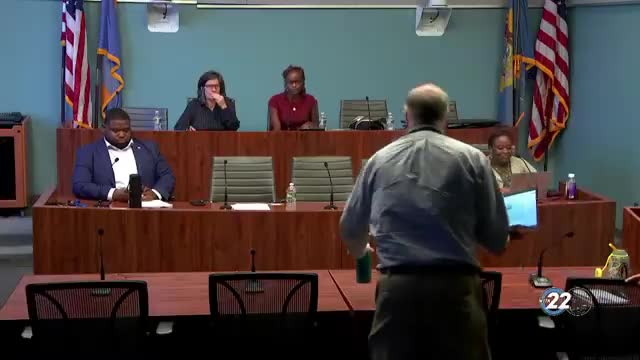
Summary
Public Works presented the Resilient Wilmington plan update, described completed and planned green infrastructure projects (Tina Betts Amphitheater stormwater capture, Southbridge Wilmington Wetland Park, Cool Springs outdoor classroom, Adam Street green infrastructure), reported grants from DNREC, FEMA and DEMA, and previewed a Lower Brandywine
Lisonbee Quimby and Brian Lennon of the City of Wilmington Department of Public Works briefed the intergovernmental committee on June 4 about Resilient Wilmington, the city’s multi‑department climate resilience plan, completed projects and planned studies.
Quimby, who oversees environmental and sustainability programs for Public Works, said the Resilient Wilmington plan was developed with DNREC grant support beginning in 2018 and was released in June 2022. She said the plan assesses current and future risks — including rising temperatures and sea‑level rise — and recommends actions such as expanded green infrastructure, shoreline raising in low‑lying areas, and aligning the city’s work with the state climate goal of reducing greenhouse gas emissions 50% by 2030.
Brian Lennon, assistant water division director, described recent and in‑progress projects. He highlighted the Tina Betts Urban Arts Amphitheater, which integrates green infrastructure and stores about 20,000 gallons of stormwater from roughly four acres of off‑site drainage for up to a two‑inch rainfall event. He described the Southbridge Wilmington Wetland Park project, which redirects stormwater away from residential streets and basements into a restored wetland that doubles as public green space and reduces combined sewer overflows.
Lennon summarized the Lower Brandywine flood study begun after Hurricane Ida (which made landfall in the region on Sept. 2, 2021). He said the city obtained a grant from Delaware Emergency Management and FEMA to study the Lower Brandywine; the grant totaled $500,000 from DEMA with a $166,000 match from Public Works to model river flows and evaluate shoreline protection alternatives. The study’s outreach identified three solution categories: a shoreline flood wall (high cost; more obstructive), a mid‑landscape approach with living shoreline and buried berm to preserve river access, and an inland option that would protect further inland properties but leave some parcels vulnerable. Lennon said the project team and community favored the mid‑landscape solution in most places and that the city plans additional public meetings in late June to present results and pursue construction grants.
Quimby and Lennon noted that the scale of some protections is large: a study estimate showed that fully berming Southbridge to protect against major storm events could cost on the order of $3 billion — well beyond city funding — so the city is pursuing grant funding and incremental, multi‑benefit projects. They also reported progress such as procuring hybrid electric vehicles for public works, building outdoor classrooms at Cool Springs Park and Herman Holloway Park, and conducting an urban heat study with the University of Delaware.
Residents and neighborhood advocates — including organizers from Northeast Rising, Northeast CERT and community groups — urged the city to prioritize vulnerable neighborhoods such as Northeast Wilmington and to speed up implementation. Several residents recounted damage from Hurricane Ida, noted clogged or sediment‑filled drains in their neighborhoods and were advised to submit 311 service requests for clogged storm drains; staff also pointed to long‑running historical studies of flooding in Southbridge dating back decades. The presenters said project funding will likely require tens of millions of dollars for mitigation construction and encouraged community members to support outreach to state and federal funding partners; they noted the Building Resilient Infrastructure and Communities (BRIC) federal program had been canceled at the federal level and that replacement funding would be important.
Public Works said the Resilient Wilmington working group meets roughly quarterly and includes interdepartmental and occasional state and county participation. Staff asked council members to help with public engagement, and committee members urged the city to increase coordinated public outreach so residents have clear opportunities to review and influence design choices for projects in their neighborhoods.
The committee did not vote on actions; staff said they will continue public outreach and pursue grant funding for construction.