Get Full Government Meeting Transcripts, Videos, & Alerts Forever!
Get email alerts on the Infrastructure Funding topic
No spam. Unsubscribe anytime.
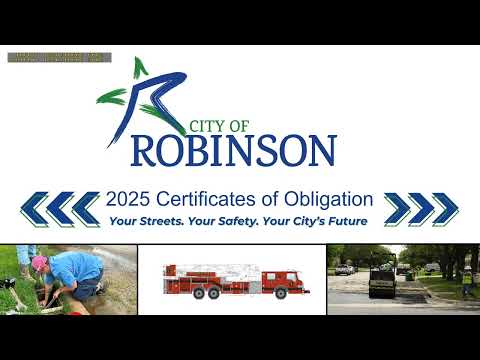
Robinson considers up to $33 million in certificates of obligation for ladder truck, streets and water upgrades
Summary
City Manager Craig told a town hall the council is considering issuing up to $33 million in certificates of obligation to buy a ladder truck, repair about 37 miles of streets and fund water/utility projects; officials outlined costs, right‑of‑way limits, funding sources and a potential tax impact.
Robinson city leaders outlined a plan to issue up to $33,000,000 in certificates of obligation to finance a ladder truck, major street work and water‑system improvements, City Manager Craig said at a town hall meeting.
Craig said the proposed borrowing would be split into three categories: up to $2,500,000 to pay for a ladder fire truck, up to $22,500,000 for improvements to existing streets and up to $8,000,000 for utility‑system and water‑plant improvements. "Council's looking at issuing up to 33,000,000 in certificates of obligation," Craig said during his presentation.
The proposal matters to property owners because part of the debt service would be supported by property tax revenue. Craig said preliminary April values indicate the debt service portion could amount to a 6.17¢ increase in the tax rate for the portion that funds debt service; the presentation included a table showing $61.70 per year for each $100,000 of assessed value (about $201 a year for a home valued at $328,000 under the assumptions used in the slides). He cautioned certified values will not be available until July 25.
Why officials say the borrowing is needed
Officials said the city currently has roughly 65 streets — almost 37 miles — that need either reconstruction or reclamation and that fully fixing all those streets was previously estimated near $40,000,000. Craig told attendees the city has already addressed about eight miles of the worst roads and has roughly $5,000,000 in prior debt proceeds available for projects (with much of that money likely to be spent on Greg Drive). "Total cost to do either reclamation or reconstruction ... is just under $40,000,000 to fix all the roads that currently need to be fixed," Craig said.
Street work would focus first on arterials and collectors that carry higher daily traffic, officials said. The presentation named candidate streets including Greg Drive, Newland, East Moonlight, Tate, Old Robinson Road and parts of Lindell. Craig said traffic counts showed about 3,000 vehicles per day on portions of Newland and more than 1,000 on East Moonlight during a summer count. The slides and spoken remarks distinguished two construction approaches: reconstruction (remove and rebuild the full road structure) and reclamation (grind and stabilize existing pavement and place new asphalt).
Right‑of‑way and design limits
City staff warned a main constraint on widening or changing road cross sections is missing right‑of‑way along many older streets. Craig said many lots were never platted when they were subdivided, so the city lacks the legal right‑of‑way needed to widen roads or place utilities outside the travelway. "We can maintain the road at the current width ... We can't widen them unless we get the right of way," he said, noting acquiring additional right‑of‑way can be costly and time consuming.
Officials described scenarios where widening would be limited by adjacent buildings or cemeteries and noted the city is not planning wholesale widening of most residential sections; the council's stated priority is converting high‑traffic chip‑seal collectors and arterials to thicker asphalt sections and addressing safety improvements such as left‑turn lanes and student crossings where feasible.
Utilities and water planning
Craig summarized recent utility work — sewer rehabilitation using pipe bursting, water‑line upsizing and ongoing reservoir lining work — and framed the $8,000,000 utility portion as targeting additional water‑plant improvements and system upgrades. He said the utility fund already supports many capital projects and that utility relocation costs, when needed, would be paid from utility revenues, not by property tax.
Funding mechanics and other revenue sources
City staff explained certificates of obligation were chosen for lower interest costs compared with a lease purchase and that issuing debt this way could save an estimated $200,000–$250,000 over 10 years versus a lease. Craig said the council must decide on issuance timing in mid‑ to late July. The presentation also described other funding: about $5,000,000 in prior debt proceeds earmarked for Greg Drive, American Rescue Plan Act (ARPA) funding used to replace the Greg Drive bridge and to buy a fire engine, and a tax increment reinvestment zone (a local redevelopment financing mechanism) planned to support widening in the industrial/commercial area near the Walmart mill and Robinson Industrial Park. "We're using [ARPA] money to replace the Greg Drive bridge," Craig said.
Public questions and timing
Residents asked about who pays for new subdivision infrastructure; staff explained developer‑installed infrastructure is built to city standards and then accepted by the city for ongoing maintenance. Questions also covered prioritization criteria; Craig said the city will weigh road condition, traffic volume, required right‑of‑way acquisition, needed utility work and project timing when sequencing work and that the city intends to prioritize arterials and collectors so the most widely used roads benefit first.
On schedule, staff said the council planned another public meeting in early July and expects to advertise and bid projects later in the year if the borrowing is approved. Craig said the city must generally expend bond proceeds within five years and that staff will coordinate design, bidding and construction timing with school calendars when possible to reduce disruption near schools.
No formal vote
The presentation and Q&A were informational; the town hall did not include a council vote. Craig and other staff took public questions and said the council will make a borrowing decision at a later, publicly noticed meeting.
Where to find more information
Staff said the presentation and materials will be posted on the city's website; officials encouraged residents to review the slides and ask follow‑up questions to city staff.