Get Full Government Meeting Transcripts, Videos, & Alerts Forever!
Get email alerts on the Fy26 Guidelines topic
No spam. Unsubscribe anytime.
Grants committee recommends FY26 operating and Thrive guidelines, sets fiscal sponsor fee and eligibility rules
Summary
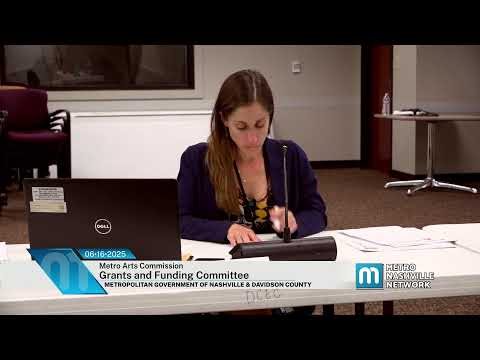
The Metro Arts Grants and Funding Committee on June 16 recommended FY26 operating and Thrive grant guidelines with procedural clarifications and two substantive policy choices: a flat $750 fiscal‑sponsor payment for Thrive awards and a rule that an organization may receive only one Metro Arts grant (operating or Thrive) per cycle.
The Metro Arts Grants and Funding Committee on June 16 recommended FY26 operating and Thrive grant guidelines to the full Metro Arts Commission, endorsing specific procedural changes including (1) clarifying that grant contracts go into effect when fully executed by all parties, (2) adding a short three‑day correction period after technical review, (3) changing “midpoint check‑in” language to “grant check‑in,” (4) removing the Thrive category’s public‑art/mural eligibility for this cycle, (5) allowing community members serving on PAC and CARE committees to apply for Thrive grants provided they do not participate in review or recommendation, (6) selecting a standard $750 fiscal‑sponsor administrative payment for Thrive projects, and (7) adopting an explicit policy that organizations cannot receive both an operating and a Thrive award in the same cycle (option 1).
The committee’s recommendations package is intended to go to the full Metro Arts Commission the week after the committee meeting, then to Metro legal and the Metro Council for final approval and council filing. The decisions shape application deadlines, award calculations and panelist recruitment for the FY26 grant cycle.
Staff presenter Ashley walked committee members through the proposed edits to both the operating guidelines and the Thrive guidelines. On operating support, Ashley told the committee that the guidelines are largely unchanged from the prior year but include reorganized language, updated dates, and small clarifications. On contracts she said: “this contract goes into effect on the date that the contract is fully executed,” and staff will adjust guideline language accordingly. The operating guidance retains the current size categories and scoring formula and keeps the policy that applicants who score 70 or above are eligible for operating grants under the established funding formula; staff noted award sizes remain subject to scaling based on available budget.
The operating guidelines add a new size‑category transition rule to moderate how organizations that are just over a threshold are scaled: organizations up to 10% over the upper threshold will receive an award calculated at the midpoint percentage between the two categories (example provided in packet). Staff also proposed a “grant check‑in” (renamed from midpoint) process to increase engagement with grantees during the funding period and flagged plans to develop the details outside of the guidelines.
On Thrive grants, staff recommended several changes. Thrive maximum requests remain $15,000; staff recommended removing Thrive public‑art (murals/sculptural) project eligibility for this cycle because the commission does not yet have a clear evaluation process for those project types. Thrive will add a new rubric question asking applicants to identify communities served and describe community involvement in planning, decision‑making or art‑making; the rubric will also include a prompt for first‑time applicants to provide additional context.
Fiscal sponsorship was a substantive committee decision: staff presented three options for covering fiscal‑sponsor administrative cost and recommended a flat $750 per award provided in addition to the approved grant amount (option 2). Committee members supported standardizing the payment (and removing the need for artists to negotiate a sponsor fee inside their budgets); staff said the $750 would be added to each award overseen by a fiscal sponsor and could be declined by the sponsor if they chose not to accept it.
Committee members debated whether small and micro organizations should be permitted to apply for both operating and Thrive funds in the same cycle. The committee recommended option 1: organizations may receive only one Metro Arts grant per cycle (either operating or Thrive). Staff said they will assist applicants in selecting the better fit and will determine allocation percentages to size categories during the commission allocation conversation.
The committee also reviewed proposed grant‑panelist criteria and conflicts language. Panelist eligibility will require residency in Nashville/Davidson County, completion of the panel application, attendance at orientation and availability for independent review plus an in‑person panel; ineligibility includes Metro employees, elected officials, commissioners and their household members, and applicants or parties with financial relationships to applicants.
Motions to recommend the operating guidelines (with edits including contract start‑date clarification and renaming of midpoint check‑in) and to recommend the Thrive guidelines (with the edits summarized above, the flat $750 fiscal sponsor payment, removal of PAC/CARE prohibitions, and the single‑grant‑per‑cycle policy) were both moved, seconded and approved by the committee for referral to the full commission the following week. Staff said they will incorporate the committee edits, send the materials for final legal review, and aim to include them in the commission packet for the meeting before council filing deadlines. Committee members asked staff to present to Metro Council for an informational update two weeks before the council vote so council members have time to review and ask questions.
No funding allocation percentages to size categories were set at the committee meeting; staff said allocation decisions will be made by the commission upon receiving applications and reviewing projected applicant pools and budgets.