Get Full Government Meeting Transcripts, Videos, & Alerts Forever!
Get email alerts on the Snowmobile Grooming Budget topic
No spam. Unsubscribe anytime.
Bonner County workshop adjusts Priest Lake groomer budget, preserves funds for grant matches and heavier snow years
Summary
At a Bonner County budget workshop, county staff and the Priest Lake Groomer Board discussed reclassifying a $1,500 plowing payment, increasing small-equipment and salary lines, reallocating contingency dollars into fuel and labor, and reserving $20,000 for grant-match opportunities.
Bonner County Recreation Director Mazel and members of the Priest Lake Groomer Board met with county staff at a budget workshop to revise the Priest Lake snowmobile grooming budget, discussing how to classify a $1,500 payment from Sandpiper Shores, raise small-equipment and salary lines, and allocate contingency funds for heavier snow seasons.
The discussion centered on two financing questions: whether a $1,500 payment from Sandpiper (characterized at the meeting as payment for plowing rather than a donation) should be recorded as revenue, and how best to budget for variable costs — fuel, labor and contract plowing — in a program that is moving to a forward-paying model tied to state sticker-distribution estimates. "This isn't just smoke and mirrors," Mazel said of the revenue estimates, noting state distribution numbers inform the projections but final figures arrive in July. "These are real numbers of what we have currently up to date with sticker sales, and that's how we're making this prediction for the following year if we can go to a forward paying program."
Board members and county staff proposed moving the Sandpiper Shores $1,500 from a "donation" line to miscellaneous revenue and folding the corresponding $7,000 snowplowing expense into the contracts line so revenue and expense match. The groomer board chair, Larry, confirmed Sandpiper's payment was for plowing service rather than an outright gift.
Small assets and equipment also received attention. The groomer team identified specific near-term purchases — a half-inch impact battery ($~200), an impact driver (~$350) and a floor jack (~$500) — that together total roughly $1,050. Participants suggested padding the line to cover taxes and minor extras; the group discussed setting the small-assets line between $1,100 and $1,300. Larry and field operations lead Dave Spencer described routine needs such as chainsaws, consumables and shop supplies used for preventive maintenance on the groomers.
Contingency and tracking of variable costs drove the longest debate. The groomer board proposed increasing the contingency line from $1,838 to $10,000 to ensure access to funds during heavy-snow seasons for extra fuel, labor and plowing contracts. County staff pushed to itemize known costs into fuel, labor and contract lines so the county can track spending against anticipated user-fee revenue; staff described contingency as a last-resort source that should be smaller and reserved for unanticipated needs. Participants cited a past season in which refilling fuel tanks and heavier operations produced a large, unexpected bill near season end, producing a temporary budget shortfall.
After back-and-forth about tracking and rapid access to funds during the season, the group agreed to a compromise approach: reduce the proposed contingency and reallocate some of the requested increase into specific lines for diesel/fuel and labor so those costs are visible in future budget cycles. Staff recorded a plan to set contingency at $5,000 and increase diesel and labor lines by amounts discussed at the meeting, while auditing staff and directors will finalize exact allocations and confirm which past bills (such as a large diesel refill) should have been charged to specific lines.
The workshop also approved using up to $20,000 of existing program funds as a potential match for grant applications the groomer board intends to pursue, including parking improvements at Indian Creek, Kavanaugh Bay and other safety-related projects with Idaho Parks and Recreation. "If we don't get it, we're not gonna spend it," Larry said of the match dollars; participants noted the money is state-derived funds Bonner County is holding for the program and would only be spent if a grant is secured.
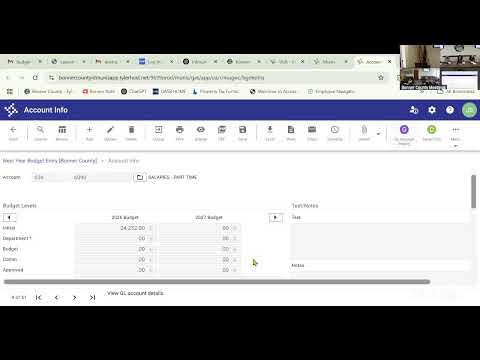
Administrative adjustments noted during the session included a proposed salary line increase and a diesel line adjustment. Staff marked an adjustment in the salary worksheet from $24,252 to $26,752 for the program and discussed raising the diesel line from $15,000 to $17,500; final bookkeeping and formal budget entries will be completed after follow-up with HR, auditing and the clerk's office. County staff agreed to provide the state sticker-sales revenue calculations used in the forward-payment projection by email.
The workshop closed with direction to the county clerk and auditing staff to reclassify revenue and expenses into the correct budget lines, finalize contingency sizing and confirm historical charges that produced past shortfalls so the current budget can be tracked more precisely during the season. The group agreed to reconvene if further adjustments are needed.