Get Full Government Meeting Transcripts, Videos, & Alerts Forever!
Get email alerts on the Proxy Voting topic
No spam. Unsubscribe anytime.
CalPERS defends use of proxy advisory research amid rising criticism
Summary
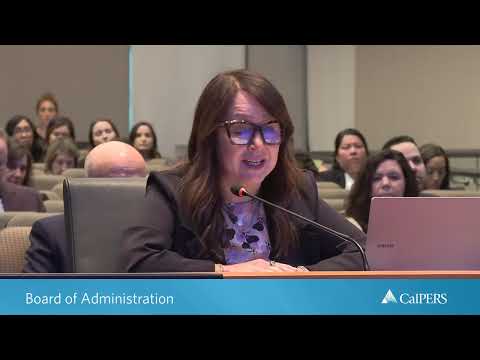
A CalPERS staff member told the board that the pension fund independently researches proxy votes and does not rely solely on proxy advisory firms, citing 2024 voting activity, alignment rates and public posting of votes.
A CalPERS staff member told the California Public Employees Retirement System board that CalPERS conducts its own, extensive research before casting proxy votes and does not "rely solely" on recommendations from proxy advisory firms such as Glass Lewis and ISS.
CalPERS' investment team, the staff member said, voted proxies at more than 10,000 share owner meetings in the 2024 calendar year — a total the presenter said equated to about 95,000 individual votes across 63 countries. "As a long term share owner, we view proxy voting as 1 of the most important tools to influence a company's governance practices," the staff member said, listing "say on pay, board independence, board diversity, board expertise" as typical issues.
The staff member framed the remarks as a response to public criticism of proxy advisory firms, including a recent comment by "a prominent CEO" who called such firms "a cancer," and members of Congress proposing SEC regulations that could increase costs and legal risk for users of advisory services. The presenter said those proposals and rhetoric risk discouraging investors from using proxy advisory research and, in the presenter's view, could "silence shareholders" and undermine fiduciary duties.
Explaining CalPERS' process, the staff member said the fund's proxy voting decisions are guided by the board-approved governance and sustainability principles and the system's proxy voting guidelines. The presenter said CalPERS uses multiple research providers, including Glass Lewis and Institutional Shareholder Services (ISS), and that CalPERS casts votes through an electronic platform provided by Glass Lewis. "CalPERS doesn't, nor has it ever relied solely on these recommendations to make our voting decisions," the presenter said.
To illustrate independent decision-making, the presenter cited alignment statistics for 2024: CalPERS voted in alignment with corporate management's recommendations about 74% of the time, while Glass Lewis aligned with management about 90% of the time. The presenter said CalPERS makes its proxy votes public on its website so companies and the public can see how the fund will vote.
The staff member also said the United States is currently the only market considering the elimination of proxy advisory firms and argued that eliminating the firms would weaken corporate governance, reduce transparency and harm institutional investors. No board motion or vote on proxy-adviser regulation was taken during the report.
The report closed with an affirmation of proxy advisory firms' role in providing research grounded in governance best practices and a reminder that CalPERS' staff undertake "hundreds of hours" of work reviewing corporate proxy materials before voting.