Get Full Government Meeting Transcripts, Videos, & Alerts Forever!
Get email alerts on the Sewer Rates topic
No spam. Unsubscribe anytime.
Port Orchard finance committee debates proposed six‑year sewer rate plan, ERU reallocation for commercial accounts
Summary
City staff and councilmembers questioned a consultant-backed proposal that would rebalance sewer charges over a six-year cycle, simplify nonresidential rate classes to ERU-based charging, and phase annual increases to meet capital and operating obligations.
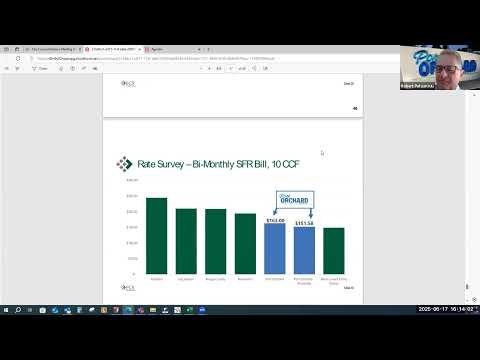
Noah Crocker, finance director, told the Port Orchard Finance Committee on June 17 that the city’s sewer rate study recommends simplifying nonresidential classes into a single ERU‑based rate and phasing increases over a six‑year period to meet projected operating and capital obligations. "We need to raise in total additional 3 per 3 and a half percent of revenue per year to meet those obligations," Crocker said, describing the consultant’s output and how it was translated to residential and commercial rates.
The discussion matters because the proposal would change how sewer customers — especially commercial accounts — are charged. Committee members pressed staff for clarity on how ERUs are assigned, how commercial winter usage will be verified under the Westsound operating arrangement, and why the study produces different per‑ERU rates for residential and nonresidential customers.
Crocker summarized several technical points from the consultant model: the city currently bills residential customers a flat base of $1.63 per ERU (bimonthly) and the study would start 2026 at approximately $1.51 per residential ERU with incremental increases in later years; nonresidential per‑ERU rates would start higher, around $2.35 for the first year. "The nonresidential would start at $2.35 ish and then adjust every year as well," Crocker said. He said the consultant delivered the modeling as an output of cost‑of‑service inputs rather than a targeted front‑loaded rate, and that the final report is expected July 20. Crocker added the council will see a rate adoption package in September when staff brings the general sewer plan and rate recommendations to full council for rate setting.
Councilmember John Morrissey repeatedly asked whether the city could present a single, flat rate for the six‑year cycle to make budgeting easier for residents. "People will have an easier time trying to budget with a static number rather than a changing number," Morrissey said. Crocker and other staff pushed back that inputs are not static — ERU counts, operating costs and capital needs change year to year — and that a flat early rate could overcharge present customers to prepay future obligations.
Councilmember Fred Chang asked when the ERU assignment for a specific project is determined and whether that is a policy or engineering decision. Crocker said ERU counts traditionally come from project engineers’ usage estimates and that the city’s review compares those estimates against comparable facility types; Rebecca Zick, staff member, clarified the numeric standard: "1 correction, 180 gallons per day is our ERU count for residential."
Committee members also probed why the model shows different per‑ERU dollar rates for residential and nonresidential customers, and asked staff to add additional math and scenario outputs to the consultant work before contract closeout. Crocker invited specific questions to relay to the consultant and said he wanted the contract closed at the end of the month.
The committee did not vote on rates at the meeting. Crocker described next steps: staff will finalize the consultant report (due July 20), package a rate ordinance and general sewer plan for council review (anticipated in September), and continue annual reconciliation of commercial accounts under winter‑usage calculations specified by the Westsound arrangement.
Follow‑up items raised by council included asking the consultant to model a flat six‑year smoothing option and to show the math that produced the differing residential and nonresidential per‑ERU rates. Morrissey said he would compile questions and provide them to Crocker in the coming days so staff could close the consultant contract without extension.
The committee closed the sewer discussion after agreeing to continue the item at future meetings and to receive the consultant’s final report before any ordinance is brought forward for adoption.