Get Full Government Meeting Transcripts, Videos, & Alerts Forever!
Get email alerts on the Land Use Fees topic
No spam. Unsubscribe anytime.
Builder asks Brentwood to postpone impact-fee payment until occupancy; board delays decision
Summary
A Brentwood resident seeking to build two homes asked the Select Board to allow payment of impact fees at certificate-of-occupancy rather than at building-permit issuance; board members expressed concern about precedent and enforcement and asked staff to research prior practice.
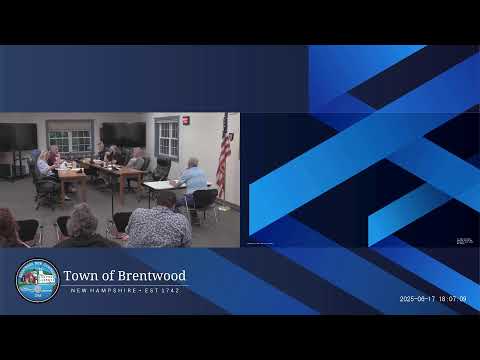
Brentwood, N.H. — A resident building two homes asked the Select Board on June 17 to allow payment of impact fees at the time a certificate of occupancy is issued rather than at building-permit issuance.
Al Bailey told the board he is building two houses and asked for a postponement of roughly $20,000 in impact fees until occupancy because carrying costs are high: "If we could postpone the impact fee till the time of occupancy permit versus time of, getting the billing permit, it would be quite helpful for us." He said one of the homes is to house his daughter and the other to offset carrying costs.
The nut graf: Board members and the town administrator cautioned that changing the payment timing could create a precedent that would have to be applied uniformly. Mark Kennedy, the town's senior administrator, said collection at permit issuance simplifies enforcement: "When you do for one, you must do for all." He asked whether the town would be prepared to take enforcement actions to collect if occupants moved in without payment.
Discussion and outcome: Board members expressed sympathy for Bailey's financial concerns but also worry about fairness and enforceability. Kennedy said he would search the records for prior exceptions; Bailey said he believed the town had allowed similar accommodations in earlier large developments but could not point to specific files. The board did not adopt a policy change; Bailey withdrew his motion and the board asked staff to investigate precedent and return with information at the July 1 meeting.
What was recorded: No formal fee waiver or ordinance amendment was made. The board did not vote to change the timing of impact-fee payments; members instructed staff to research past approvals and report back at the next meeting.
Why it matters: Timing of impact-fee collection affects developers' cash flow and the town's cash management and enforcement posture. The board emphasized that any deviation from the standard timing would need clear, consistently applied criteria and a plan for collection enforcement.