Get Full Government Meeting Transcripts, Videos, & Alerts Forever!
Get email alerts on the Planning And Zoning topic
No spam. Unsubscribe anytime.
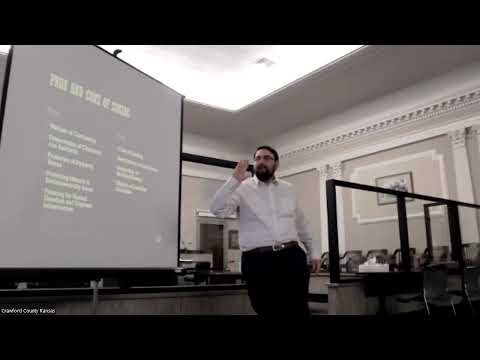
Crawford County consultant outlines purpose of zoning, ties it to comprehensive 20‑year plan
Summary
Consultant Josh Allen explained how zoning gives counties legal control over land use, described the county's proposed comprehensive plan and survey results, and said zoning is the established mechanism to manage issues including wind and solar siting, infrastructure and economic development.
Josh Allen, consultant for Crawford County and attorney with Adams Jones Law Firm, told residents that zoning is the county’s primary legal tool to control land use and said the county’s comprehensive plan will set 20‑year priorities.
“Comprehensive planning is about trying to create a 20 year plan for the community,” Allen said, describing the plan as a roadmap that covers housing, infrastructure, roads, education and public services as well as zoning. He said zoning gives the county “home rule authority” to set rules for how land is used inside county boundaries and that courts have recognized zoning as the normal regulatory means to do so.
Allen said the county currently uses three broad zoning categories—residential, agricultural and commercial—and described conditional uses, setbacks, building height limits, parking requirements and other tools counties use to control both what is allowed on a property and how structures are sited. He urged residents that creating clear rules reduces disputes and litigation: “If everybody knows what the rules are, there's less disputes because we already know what we're doing.”
Why the plan matters: Allen said zoning helps counties pursue economic goals and public safety. He said zoning can protect property values, preserve historic or scenic areas, and prevent placing hazardous uses such as fertilizer plants next to water treatment facilities. He argued that zoning can also make the county eligible for certain grants and funding—such as community development block grants—because some funding programs require specified land‑use or infrastructure conditions.
On renewables and moratoria: Allen described a county moratorium on solar that has already been put in place and explained his view that legal control is stronger when comprehensive zoning covers the county’s entire boundary. He said, “for a county to actually have control over its needs and bounds … it has to be zoned for its entire boundary.” He noted that other counties that have allowed wind or solar adopted zoning rules after development or after court decisions; he cited a state Supreme Court decision (unnamed in the presentation) that rejected separating air rights from land rights and said counties responded by adopting zoning rules and setbacks for turbines.
Agricultural exemptions and limits: Allen said the county is a “right to farm” state in practice and that agricultural zones allow a broad set of farm uses; many routine farming activities are treated as exempt from ordinary planning restrictions unless they create public‑safety hazards subject to state agencies such as the Kansas Department of Agriculture or the Kansas Department of Health and Environment. He also said water rights and some other authorities rest with state or federal agencies, not the county.
Infrastructure and economic development: Allen pointed to limited arterial roads near existing industry as a barrier to growth and said the comprehensive plan can prioritize road and infrastructure projects that would make industrial areas more usable and help the county apply for outside funding. He said the plan’s goals should be achievable steps the county pursues over 20 years to spur jobs and positive population growth.
Public engagement and survey: Allen described the outreach process for the comprehensive plan and said the survey gathered public input to help prioritize projects. He reported the survey response rate as “right around 28%” of those contacted and said public hearings will follow draft plan circulation.
Ending: Allen encouraged residents to use the county website to access the survey and materials and repeated that the comprehensive plan is meant to be an inclusive, long‑range guide for land use, infrastructure and services.