Get Full Government Meeting Transcripts, Videos, & Alerts Forever!
Get email alerts on the Economic Development Incentives Fair Report topic
No spam. Unsubscribe anytime.
Committee reviews annual FAIR report on Bethlehem economic-development incentives
Summary
The Community Development Committee reviewed the 2024 Financial Accountability Incentive Reporting (FAIR) hearing covering LERTA zones, the CRIZ program, the enterprise zone, several loan funds and proposed use of in-lieu affordable-housing payments; no formal votes were taken.
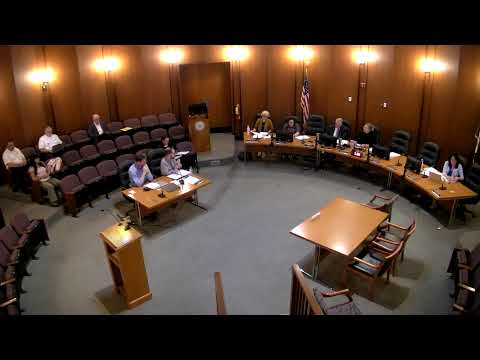
The Community Development Committee of the Bethlehem City Council on a hearing day reviewed the city’s 2024 Financial Accountability Incentive Reporting (FAIR) presentation, receiving updates and asking staff questions about LERTA zones, the City Revitalization and Improvement Zone program, the enterprise zone, several legacy loan funds and how in-lieu affordable-housing payments will be used.
The FAIR presentation — delivered by Sean Ziller, administration representative, with Alex Miller, economic development coordinator, and Laura Collins, director of community and economic development — summarized program inventories, valuation reports and beneficiary impact statements for 2024. Committee chair Hilary Kwiatek and council members Grace Kramsy Smith, Kira Wilhelm and Rachel Leon asked staff about zone expirations, fee-in-lieu collections and program administration.
Why it matters: FAIR is the council’s annual transparency review of tax and non-tax incentives the city uses to spur private investment and job creation. Committee members pressed staff about whether incentives are achieving intended outcomes, how fee‑in‑lieu funds will be allocated for affordable housing and whether legacy loan programs are being used.
City staff described the status of several major incentives. On LERTA (Local Economic Revitalization Tax Assistance), staff said Bethlehem maintains two active LERTA districts on the South Side: an affordable-housing LERTA adopted in 2021 that expires at the end of 2026, and a South Side LERTA 2 adopted in 2023 that expires at the end of 2027. Staff reported the city’s relinquished real-estate tax revenue from those LERTA abatements in 2024 was approximately $1,300,000. The presentation explained the programs use graduated 10‑year abatements tied to post-improvement reassessments and noted different in-lieu fees apply by ordinance — $25,000 per unit for one affordable-housing LERTA ordinance and $52,320 per unit for parcels in South Side LERTA 2.
Alex Miller, the city’s economic development coordinator, said the two South Side LERTA districts differ in geography and ordinance language and that roughly 40% of acreage in South Side LERTA 2 has or will receive abatement while about 5% of acreage in the affordable-housing LERTA has done so. Miller added that the department has collected about $750,000 in combined fee-in-lieu payments since 2021 from four projects across the two zones. When asked how that money will be spent, Laura Collins said the department is “working on that internally” and that staff have proposed earmarking the funds for the Gateway on Fourth Affordable Housing project, but no final allocation was reported at the hearing.
On the City Revitalization and Improvement Zone (CRIZ) program — administered locally by the Bethlehem Revitalization Improvement Zone Authority (BRIA) and authorized by the Commonwealth — staff noted the CRIZ evaluation covers taxes paid in 2023 and returned to the authority as increment in 2024. The presentation listed five active CRIZ projects and reported beneficiaries received a little over $1.5 million in tax incentives in 2023; staff said the increment returned to the authority (reported separately) is used to distribute to property owners, pay debt and fund a portion of administration and public projects. Staff reported private investment associated with CRIZ projects and said there were 567 employees in the CRIZ zone (about 488 full time), excluding construction jobs.
Regarding the enterprise zone, staff reported that Bethlehem’s enterprise zone designation expired Sept. 30, 2024. Staff told the committee that many enterprise-zone benefits remain accessible while the city considers renewal: the tax-credit component remains available to applicants through Sept. 30, 2026, and other enterprise-zone benefits extend through 2029. Staff said renewing the enterprise zone would require a new application and a five-year strategy demonstrating continued need; they described the zone loan program as underutilized and attributed low uptake to application burdens and limited awareness among businesses.
Staff also reviewed legacy loan programs. The Bethlehem Small Business Loan Fund (BSPLF), administered by Rising Tide, made one loan in 2024 (reported value: $100,000). The Business Infrastructure Development (BID) revolving loan fund had no loan approvals in 2024. Committee members and staff discussed outreach, administrative burden and whether program rules still match current business needs; Miller and Collins said the department is working to streamline processes and improve coordination with the Commonwealth, county and school district when incentives require their participation.
Sean Ziller read several project impact statements collected for the report. Reading a beneficiary comment, Ziller said: “The LERTA tax abatement was a powerful incentive for this tenant to locate their expanded operations. Having a gradual increase in property taxes helped offset startup costs for the facility.” He also read feedback saying, “The CRIZ made the project possible. We should see growth in 2025,” and that the CRIZ “was crucial to attract restaurant tenants.”
Committee members asked several follow-ups: whether LERTA renewal will be considered before the expirations (staff said renewals would be evaluated as the expiration dates approach), whether parcels could be moved between ordinances (staff said the two LERTA ordinances cover different parcel groups and were enacted separately), and whether the department will recommend program changes (staff said internal process improvements and closer coordination with partners are underway before proposing policy changes). No motions, votes or formal actions were taken during the hearing.
The hearing concluded with staff submitting the 2024 FAIR report for committee review and with committee members thanking staff for the presentation. Staff identified next steps including ongoing internal evaluation of incentive processes, continued outreach to potential applicants for enterprise-zone and loan programs, and further work on how fee-in-lieu collections should be allocated for affordable housing projects.
No public comments were recorded at the start of the meeting.