Get Full Government Meeting Transcripts, Videos, & Alerts Forever!
Get email alerts on the Housing Policy topic
No spam. Unsubscribe anytime.
Kirkland adopts middle‑housing code changes; council splits on affordability fee
Summary
Council voted to adopt ordinance 4905 implementing state middle‑housing rules and new local provisions. The package includes early adoption of some state parking rules and a city approach to inclusionary requirements; the final vote was 5–1 on the ordinance, with one councilmember opposed to the affordability fee.
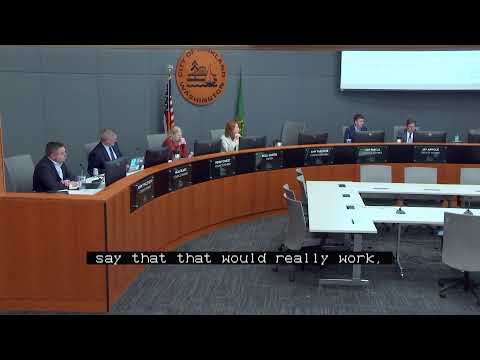
KIRKLAND, Wash. — The Kirkland City Council on June 17 adopted Ordinance 4905, implementing state middle‑housing code updates and local amendments that change parking standards, ADU and duplex/townhouse allowances, and add an inclusionary fee for larger single‑family houses.
Staff from planning and the city manager’s office (Adam Weinstein and Scott Guder) explained the choice between three parking‑standards options: retain a hybrid of existing and House Bill 1110 rules for a short period, or adopt the requirements of Senate Bill 5184 early. Staff and the Planning Commission recommended early adoption of the SB 5184‑style parking standards to avoid a short, complex interim regime required by HB 1110 that would apply from July 1, 2025 to the end of 2026.
Council debated an affordable‑housing per‑square‑foot payment in lieu tied to new construction over 2,000 square feet. Staff proposed a methodology based on a 2024 sample of single‑family permits and recommended a $15 per square‑foot fee on square footage exceeding 2,000 — with a 2027 implementation date to allow additional study and refinement. The city manager’s package also requires the planning director to return by June 30, 2026 with a refined payment‑in‑lieu methodology.
Councilmember concerns centered on the timing and design of the fee. Councilmember Pasco voted against the ordinance, saying he opposed adding the new fee at this time and urging more collaboration with the building community. Other councilmembers supported the ordinance as a balanced package that pairs increased capacity from middle‑housing rules with targeted affordable‑housing requirements and a delayed effective date designed to allow refinement.
Outcome: The ordinance and related manager amendment passed (roll‑call vote 5–1). The city manager’s amendment added: (1) a 2,000‑square‑foot exemption for replacement structures and (2) a requirement that staff propose refined payment‑in‑lieu methods to council by June 30, 2026.
Ending: Staff will implement adopted changes, continue engagement with builders and stakeholders, and return to council with the payment‑in‑lieu refinement and related policy proposals before the 2027 implementation window.