Get Full Government Meeting Transcripts, Videos, & Alerts Forever!
Get email alerts on the Homelessness topic
No spam. Unsubscribe anytime.
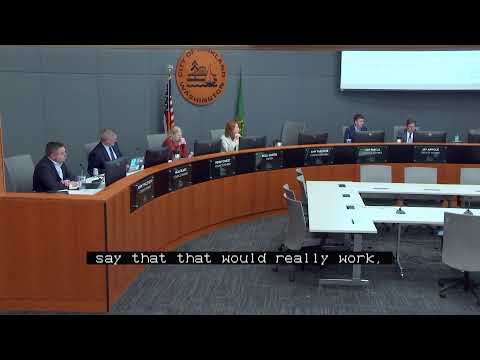
Kirkland council reviews draft homeless continuum-of-care action plan, flags staffing and shelter capacity needs
Summary
City staff presented a 70-action draft plan focused on preventing homelessness, bolstering outreach and shelter options, and connecting residents to regional subsidized housing. Councilmembers pressed for near-term support for outreach staff and more clarity on funding timing and regional coordination.
KIRKLAND, Wash. — Kirkland city staff on June 17 presented a draft Homelessness Continuum-of-Care Action Plan that lays out 70 actions to prevent and respond to homelessness locally and in coordination with regional partners.
The presentation, led by Human Services Manager Jen Boone and Juliana De Cruz, framed the plan around principles adopted in Resolution 56-31 and said the document focuses on what the city can do locally while partnering — not duplicating — county and regional services. Boone and De Cruz emphasized prevention, outreach, emergency shelter and temporary housing, and connections to subsidized permanent housing.
The plan combines 35 proposed actions and 35 ongoing activities. Staff highlighted priority investments: continuing and expanding prevention (including rent assistance supported by human services grants), strengthening the HEART outreach team (the city’s Homeless Outreach Coordinator and related positions), expanding non-congregate shelter options such as hotel vouchers and exploring tiny-home villages at faith-based properties, and ensuring local referral connections to King County’s Health Through Housing initiative.
Boone said staff’s engagement work included faith community convenings, two capacity public forums, focus groups and interviews. She cited a recent East King County point-in-time estimate of just under 2,000 people experiencing homelessness and city outreach that engaged “just over 200 unduplicated” people in Kirkland since the outreach coordinator position began. Staff shared illustrative client success stories that underlined the staff time and coordination required to get people into suitable housing.
Council members focused most of their questions on staffing and funding cadence. Councilmember Tim Chisholm asked whether the proposal to add a city-funded housing case manager and a human services supervisor (Actions 20 and the proposed supervision role) would be funded as city positions; staff confirmed they would. Boone said Action 10 — continued funding for the existing homeless outreach coordinator (HOC) — is ongoing, and Action 20 would be a new city FTE estimated under $200,000 per biennium. A Human Services supervisor to support expanded outreach was estimated under $1,000,000 per biennium.
Councilmembers and staff also discussed safety and secondary trauma faced by frontline workers. Boone recounted incidents of harassment and injury involving the HOC to underline the need for the proposed supervision and confidential workspace (Action 57). Staff proposed a hyper-centralized, city-level data tracking tool (Action 26) to help HEART team members and first responders share real-time client information, noting it would not replace regional databases.
On shelter capacity, staff recommended continuing the Hotel Set-Aside program and Severe Weather Emergency Hotel Set-Aside (Actions 30 and 24) and exploring non-congregate short-term shelter at faith-based properties (Action 39) and a feasibility study for a tiny-home village (Action 38). The tiny-home estimate shared in the presentation was roughly $1,000,000 per year in operating costs, but staff said the item on the table was feasibility study only.
Staff asked council for feedback to refine priorities and to identify gaps; they plan further stakeholder outreach and a public town hall before returning an updated plan to council in the fourth quarter. Staff also flagged timing: several ongoing actions rely on one-time funding now scheduled to end, and some proposed staffing additions would be candidates for the 2027–28 budget cycle.
Council direction and next steps included requests that staff: return to council earlier if outreach capacity was judged critically under-resourced (several council members urged mid-biennial budget options), refine cost and funding timing for priority items, and deepen engagement with regional partners so local and county roles are clearly aligned.
Ending: Staff will circulate the draft to boards, commissions, nonprofit providers and the faith community, collect additional feedback through an online form and a town hall, and return to the council with a revised plan in late 2025.