
Anchorage staff pitch crane use ordinance that would let Matson own Port cranes while preserving limited municipal access
Get AI-powered insights, summaries, and transcripts
Subscribe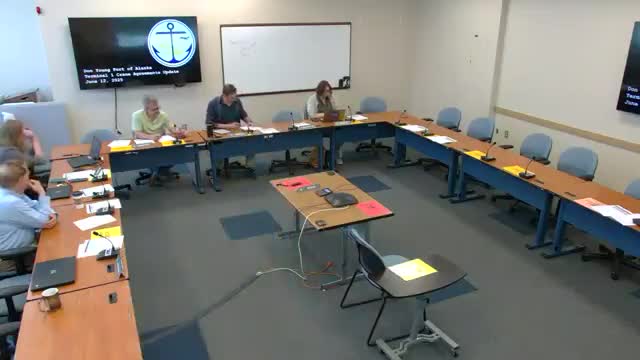
Summary
Municipal staff briefed the Assembly committee on a negotiated crane-use agreement with Matson that would have Matson own and operate new cranes at the Port of Alaska; the use agreement is scheduled for introduction and public hearing June 24, while the separate purchase agreement remains on hold.
Municipal staff told the Assembly Infrastructure Enterprise and Utility Oversight Committee of the Whole on June 12 that the crane-use agreement with Matson — an ordinance scheduled for introduction and public hearing on June 24 — would let Matson own and operate container cranes at the rebuilt Port of Alaska while preserving limited noncommercial and transient municipal access.
Becky Winpearson, municipal manager, said the construction contract for the Port has already been approved but the crane purchase agreement remains on hold while Matson decides whether to repurpose existing cranes or buy new ones. "The only thing in front of you right now is the crane use agreement," Winpearson said. "We have language that both parties are comfortable with, and that is what is going to come to you for introduction on the 06/24 meeting."
The draft use agreement, Winpearson and John Daly of the Port of Alaska said, reserves operational flexibility for the municipality in two broad categories: noncommercial uses tied to defense and emergency response, and limited third-party commercial or transient uses. Daly described the noncommercial carve-out as covering Department of Defense, Department of Homeland Security and FEMA requests, where consent "would not be reasonably withheld" though Matson might charge a fee and must staff the cranes. For third-party commercial users, the agreement treats short-term or infrequent calls as "nonpermanent" and not to be unreasonably denied; staff said a use repeated eight times within any four-year period would still be considered nonpermanent under the draft language.
Several committee members pressed staff on why the municipality is not purchasing cranes directly. "Why didn't we buy these cranes?" an assembly member asked, noting the cranes' cost is small relative to the overall project. Winpearson and Daly said two practical constraints drove the model: the high capital cost (staff cited an estimated $120,000,000 for purchase/transport/installation) and federal "Buy America" requirements tied to federal funding for the dock. Daly said most large cranes are manufactured abroad and federal funding can make procurement difficult; Matson, as a private purchaser not using federal grant dollars, would not be subject to the same Buy America restrictions.
Committee members also asked about cyber security and foreign-made equipment. Daly said industry reporting raises concerns about embedded spyware in some foreign-made cranes but that "there's little or no documented cases of that actually happening." Winpearson said software and cybersecurity protections are issues to be addressed in the crane purchase agreement, which staff intend to negotiate to protect the municipality if Matson procures cranes with embedded risks.
Committee members asked whether approving the use agreement now could lock the municipality into terms that disadvantage it if Matson later declines to buy or operate the cranes. Winpearson said the administration prefers to "secure as many components of this relationship now" to limit future delay or paradigm shifts, but listeners were told the use agreement would not be executed until the purchase agreement terms — including the not-to-exceed purchase price — are finalized. "At this point, we will not plan to execute this until we have the purchase agreement in place," Winpearson said.
The chair confirmed the item will be introduced as an ordinance June 24 with a public hearing; no formal vote or execution occurred at the June 12 committee meeting.
The committee discussion also flagged open dependencies and next steps: the crane-use ordinance is contingent on the still-open crane purchase agreement, and staff said any material changes to purchase terms would come back to the Assembly for review. Staff also noted they are pursuing federal funding avenues for the broader construction program and that procurement and indemnity language to address security or sourcing concerns would be incorporated into the purchase agreement.
The committee had no formal action on the use agreement at the June 12 meeting; staff said the administration will present the ordinance for introduction and public hearing on June 24 and that execution would occur only after purchase terms are resolved.