Get Full Government Meeting Transcripts, Videos, & Alerts Forever!
Get email alerts on the Energy And Infrastructure topic
No spam. Unsubscribe anytime.
Bradford County weighs Schneider Electric plan to use solar savings for courthouse, jail repairs
Summary
County staff and Schneider Electric presented a $3.6 million solar-and-capital-improvements package that would use federal tax credits and energy savings to pay for deferred maintenance; commissioners asked for options and more detail before deciding.
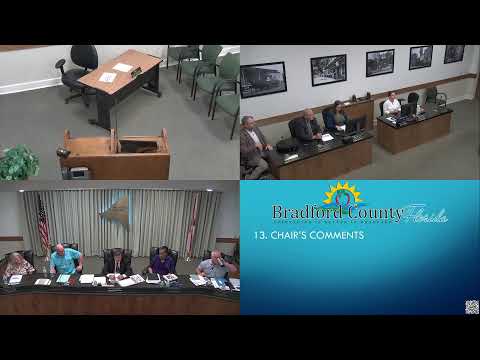
Bradford County commissioners on June 17 heard a presentation from Schneider Electric outlining a bundled program that would install solar panels, replace building lighting and pay for deferred maintenance at county facilities using projected energy savings and federal tax incentives.
The proposal, presented by Larry Perrin of Schneider Electric, would install rooftop solar and LED upgrades at several county buildings and use the resulting utility savings — together with an $800,000 federal investment tax credit and an approximately $350,000 ARPA contribution as a down payment — to fund repairs the county has deferred for years. Perrin said the company’s analysis shows a guaranteed operating-cost reduction over 20 years and additional value if panels perform through 30 years.
Perrin, Schneider Electric’s lead presenter, told the board: “We need to make sure that whatever we do is going to save the county more money than it’s going to cost the county over time.” He and a Schneider colleague described a roughly $3.6 million project cost that would be reduced by the tax credit; Schneider estimated county net investment after credits and the ARPA down payment at about $2.5 million and projected multi-million-dollar net savings over the life of the equipment.
County staff and Schneider walked commissioners through facility findings: failing roofing flashings and skylights at the courthouse, leaking holding-cell fixtures at the courthouse lockup, humid HVAC conditions at the extension office and inefficient lighting. Schneider recommended a package that combines targeted repairs with solar installations sized to produce meaningful energy reductions without producing excess power that would yield limited financial benefit under current net‑metering arrangements.
Commissioners and staff pressed technical and financial questions. Schneider said solar modules carry a 25‑year production warranty and expected physical life beyond 30 years, while inverters typically have shorter lifespans and likely replacement costs later in the project. Cassie, Schneider’s project development manager, said the modules “should be lasting 30 plus years,” and Perrin confirmed Schneider would be contractually responsible to address warrantable underperformance that would affect the firm’s guaranteed savings.
Several commissioners raised implementation choices. One asked whether the county should pursue only the jail installation because that facility has the largest utility bill; Schneider said the courthouse roof is a more convenient, higher‑value installation site because of its flat, accessible roof. Commissioners also flagged local fiscal effects: one commissioner asked about potential lost revenue to the City of Starke if county utility‑funding arrangements change and asked staff to evaluate that impact.
Schneider provided three scaled options and offered to run follow‑up analysis if the board wanted a jail‑only scenario or a smaller package. Commissioners directed staff to take the additional detail and return it for future consideration; no formal vote was taken on the project at the June 17 meeting.
Next steps: Schneider will supply jail‑only and alternative cost scenarios and further detail on inverter lifecycle costs and annual maintenance (Schneider proposed roughly annual cleaning and inspection). County staff will present the additional financial modeling to the board for a subsequent decision timeline.