Get Full Government Meeting Transcripts, Videos, & Alerts Forever!
Get email alerts on the Transportation Planning topic
No spam. Unsubscribe anytime.
Milwaukie reviews draft transportation maps, weighs ODOT transfer and grant options
Summary
City staff walked the council through draft pedestrian, bicycle, transit and roadway maps for the Transportation System Plan, sought missing projects and public feedback, and flagged possible grant and jurisdictional-transfer opportunities with the Oregon Department of Transportation.
Milwaukie officials reviewed draft Transportation System Plan (TSP) maps at a June 17 work session, asking the City Council for gaps and corrections before a public engagement push and a fall prioritization that will convert projects into a funded list.
The session, led by Planning Manager Laura Weigel, focused on pedestrian, bicycle, transit, roadway and freight classifications and a consolidated project list staff says will be prioritized later. Weigel told the council: “Did we get the projects right? Are we missing anything?” as staff urged members to identify omissions ahead of community workshops and an online Engage Milwaukie survey launching the next day.
Why it matters: the TSP will guide Milwaukie’s capital-improvement choices, local grant applications and coordination with state and regional agencies. Councilors sought clarity on which legacy projects carried forward from the 2007 plan, how the draft treats high‑priority pedestrian routes and bikeways, where smaller “spot” projects could be funded from the capital-improvement program (CIP), and whether the city should pursue jurisdictional transfer of state-owned Highway 99 to gain local control and compete for larger ODOT grant pools.
Most immediate items and staff guidance
• Project list vs. prioritization: staff emphasized the packet contained an inclusive project inventory, not a ranked priority list. Ryan Beyer, a consultant on the project, said the maps and project descriptions are intentionally specific enough for cost estimating but flexible for later engineering: “These maps are not perfect. They're not gonna be perfect because we're still talking to people,” and staff will refine language about coordination with outside jurisdictions such as ODOT and TriMet.
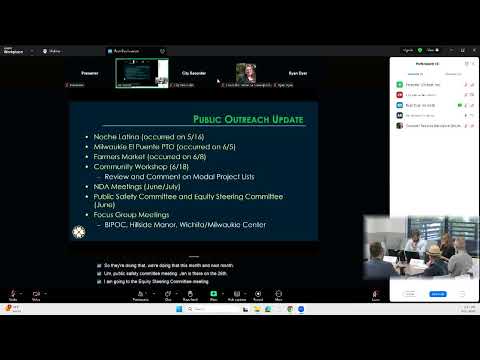
• Public engagement and schedule: staff said Engage Milwaukie would go live the night after the session, with a community workshop and focused outreach (three paid focus groups capped at 20 participants each, targeting BIPOC and other underserved groups). Staff expects a finalized prioritized project list to return to committees in August and a TSP adoption target by the end of the year or in January after a grant extension.
Pedestrian and bicycle topics
Councilors and staff reviewed the new “functional classification” for walkways and bikeways (major city walkways, city walkways, neighborhood walkways; major city bikeways, greenways, neighborhood bikeways). Staff said classification is intended to show the role a facility plays in the network and typical treatments, not to design final street sections.
Examples discussed included a sidewalk project on 30th to improve access to Minthorn Springs (identified as P‑10 in the packet) and unimproved multiuse pathway gaps behind Luelling Elementary and Michelle Park (E‑45, E‑46). Councilor Anderson and others asked whether some small, high‑value pedestrian crossings or sidewalk infill could be handled as “spot” CIP items rather than waiting years on the TSP priority list.
Bike funding and a proposed greenways CIP
Several councilors urged creation of a dedicated CIP line for greenway placemaking and low‑cost safety treatments along major city bikeways (examples cited: 20th, 19th, 40th/40th/Harvey). Staff said a defined geographic scope and toolbox of treatments would help develop a CIP project that does not compete with the small “spot” grants intended for neighborhood fixes.
Transit, freight and system coordination
The transit classification and project list in the draft reflect TriMet proposals but do not overlay existing routes in the public maps. Councilors asked staff to provide an overlay (existing vs. proposed routes) and more clarity on whether proposed routes prioritize International Way, Railroad Avenue, Lake Road or other corridors. Staff said TriMet and Milwaukie would need to coordinate service changes; adding a network request in the TSP can signal city interest to TriMet but cannot compel service changes.
Freight representatives attended the advisory process but provided limited comment, staff said; several industrial-area projects in the draft trace back to the North Milwaukie Industrial Area (NMIA) plan and earlier TSP entries.
Jurisdictional transfer and grant opportunities
Council members discussed whether Milwaukie should pursue jurisdictional transfer of parts of Highway 99 (referred to repeatedly as “99”) from the Oregon Department of Transportation to the city, which would give Milwaukie greater control over signals, speed limits and design. A council member noted a new ODOT “Great Streets” funding pot in the transportation package—staff said the biennial program was undersubscribed and that the legislature was boosting the pot to roughly $250,000,000 statewide; the session highlighted the possible strategy of packaging a jurisdictional transfer with dedicated capital funding to pay down deferred maintenance.
Council commentary emphasized tradeoffs: jurisdictional transfer can bring a large one‑time capital infusion, but also creates long‑term maintenance and signal‑operations obligations. Staff said the TSP currently contains related policy language in pieces (goals addressing ODOT barriers) but not an explicit statement directing staff to pursue transfer; multiple councilors expressed interest in adding a short policy paragraph signaling Milwaukie’s intent to pursue discussions with ODOT as part of long‑range planning.
Other operational issues raised
• Lighting and safety: councilors raised a dark stretch near the aquatic center along Railroad Avenue and asked that lighting be considered in project scoping or handled as a public‑works request.
• Johnson Creek weight restriction: a weight restriction on the city’s portion of Johnson Creek was raised; staff did not have details at the meeting and said the restriction predates the current staff workload.
• Project provenance: council requested a simple list showing which 2007 TSP projects were carried forward, built, or removed and why; staff said an internal itemized list exists and can be provided.
No formal votes or policy adoptions occurred. The work session closed with staff direction to continue outreach, provide the requested lists and maps, and return prioritized projects and proposed text edits (including an option to add a TSP call‑out on Highway 99/jurisdictional transfer) during the August review cycle. The council then moved into an executive session under ORS 192.660(2).
Sources: Statements and project references made during the Milwaukie City Council work session, June 17, 2025, as recorded in the meeting transcript. Direct quotes in this article are attributed only to speakers listed in the transcript and documented below.