Get Full Government Meeting Transcripts, Videos, & Alerts Forever!
Get email alerts on the Airport Parking Study topic
No spam. Unsubscribe anytime.
Council reviews airport-parking study, staff recommends conditional, permanent allowance with performance standards
Summary
Planning staff asked the Bloomington City Council for direction on the city’s airport-parking study and proposed code changes to take effect before the October moratorium expiration; staff recommended allowing permanent remote airport parking only through conditional-use approval with firm performance standards.
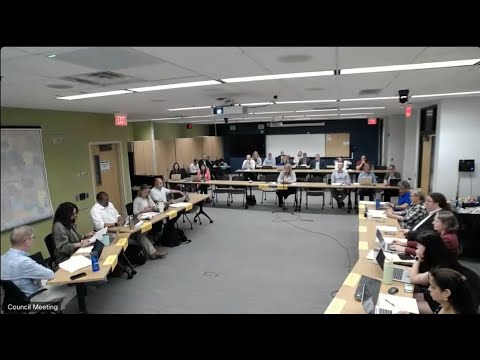
The council heard a staff briefing and public comment on the city’s airport-parking study and the moratorium that currently suspends new land-use actions in the South Loop District. Planning staff said the moratorium on land‑use actions will expire in October and asked council for direction to draft code changes ahead of that deadline.
“...the moratorium that is in place on land use actions ends this October,” planning staff told the council, and staff said they would draft possible ordinance changes to implement council guidance with hearings in July and an adoption date in August if council requests.
Public commenters described sharply different priorities. Kristen Muir of Rosa Development and a Park And Fly representative urged that long-standing off‑airport parking operators be treated as permanent, preexisting uses or grandfathered, saying Park And Fly has operated since 1988 and “this use has permanent rights. It’s time to acknowledge that fact and move on.” Dan Williamson of Park and Go described the airport’s regional importance and urged solutions that preserve airport support uses. Mall of America’s attorney Megan Rogers proposed allowing use of underutilized structured parking near light-rail stations for long‑term parking tied to transit access.
Planning staff summarized options they had analyzed: from permitting remote airport parking outright (least restrictive) to prohibiting it (most restrictive), with staff and the Planning Commission favoring a middle path. Staff recommended allowing remote airport parking as a permanent principal use only through a conditional‑use approval and only with performance standards intended to protect prospects for future dense, transit‑oriented development in the South Loop. Key concepts staff flagged for council feedback included:
- Requiring structured parking rather than large surface lots or limiting how much of a parcel may be used for surface parking; design standards could be required for structures that remain in place. - Allowing existing off‑airport operators (e.g., Park and Go, Park and Fly) to continue under specific conditions but restricting new, standalone surface‑lot operators in the district. - Permitting remote airport parking within existing parking structures (e.g., Mall of America ramps) only after a demonstration of excess capacity and subject to limits so the primary use is not harmed. - Considering maximum hotel parking thresholds and treating hotel “park‑and‑stay” packages as accessory uses rather than as independent remote‑parking facilities.
Staff noted other local examples: Saint Paul allows commercial parking as a conditional use with performance standards and Eagan’s conditional approvals for existing off‑airport parking were cited. The Metropolitan Airports Commission (MAC) operates roughly 30,500 parking stalls on airport property and imposes a shuttle trip fee for outside shuttles; staff reported MAC recorded about 119,000 remote‑parking shuttle trips originating in Bloomington last year.
Council feedback: members voiced support for a middle path rather than unrestricted permissive zoning. Councilors asked staff to draft an ordinance that: (1) treats hotel park‑and‑stay as an accessory use with a possible maximum parking cap; (2) limits new surface‑lot remote‑airport parking in the South Loop; (3) allows existing operators to continue under performance standards tied to structured parking, conversion potential and limits on the portion of any parcel used for surface parking; and (4) requires demonstrations of excess capacity for any proposal to use existing parking structures for remote‑airport parking.
Next steps: staff will draft ordinance language and performance standards for Planning Commission public hearings in July and return to council in August to meet the October moratorium deadline. Staff will continue discussions with MAC and stakeholders regarding trip-fee and operational impacts.