Get Full Government Meeting Transcripts, Videos, & Alerts Forever!
Get email alerts on the Healthcare Regulation topic
No spam. Unsubscribe anytime.
Panel debates moving physician assistants under Guam Board of Medical Examiners; concerns about board composition and prescribing rules
Summary
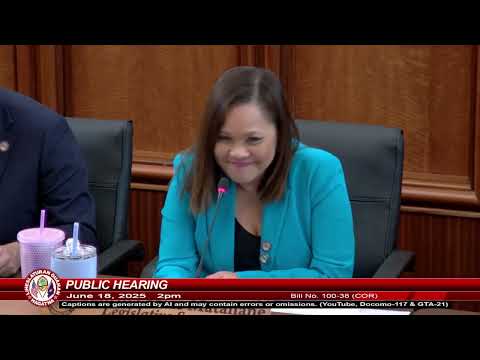
The Committee on Health and Veterans Affairs received testimony on Bill 123 and related draft language to transfer physician assistant (PA) licensure from the Guam Board of Allied Health Examiners to the Guam Board of Medical Examiners and to clarify prescriptive authority and a PA code of ethics.
Lawmakers and health providers on Wednesday examined competing views over a bill that would move physician assistant (PA) licensure and regulation from the Guam Board of Allied Health Examiners to the Guam Board of Medical Examiners and adopt a PA code of ethics and updated prescriptive rules.
Senator Therese Trelahi, identified in committee as the bill sponsor, told the panel the change would align Guam with the prevailing U.S. model in which medical licensing boards oversee PAs; she said the bill preserves current credential and continuing‑education requirements while allowing the Guam Board of Medical Examiners (GBME) to adopt rules for collaborative practice agreements.
Why it matters: Witnesses said the matter affects clinical oversight, patient safety and how scope‑of‑practice disputes are resolved. The hearings surfaced technical inconsistencies in draft language about prescriptive authority and a duplicate Guam controlled substance registration (CSR) fee, and several physicians warned that altering board composition could create conflicts of interest.
Testimony and main points
Heidi Kanata, chief children's services administrator for DPHSS, read Director Teresa C. Areola's written testimony supporting both the transfer of PA licensure to GBME and updates to PA prescriptive rules. Kanata told the committee there were 30 active licensed PAs under the Guam Board of Allied Health Examiners at the time she prepared testimony.
Ed Stanley, a PA with 23 years' practice on Guam, told the committee he supports the transfer and said much of the remaining detail could be handled in rules. "I think this is definitely a step in the right direction," Stanley said, while urging the committee to allow states or boards to set granular prescriptive limitations in supervisory agreements.
Several physicians raised objections. Dr. Ricardo Eusebio, acting chief medical officer at Guam Memorial Hospital and a former GBME chair, said the medical board's focus should be singularly on physicians because of differences in training and scope. He warned that adding nonphysician members could "dilute" a board whose primary responsibility is protecting patients and that conflicts of interest might arise if supervised clinicians sit on the licensing board that disciplines their supervisors.
Dr. Thomas Shea and other doctors questioned whether the supervising physician must hold current board certification and flagged costs and duplicative regulation. Several physicians and PAs pointed to a duplicate local CSR fee that requires both federal Drug Enforcement Administration (DEA) registration and a Guam CSR; witnesses argued the local CSR duplicates DEA oversight and increases cost without apparent benefit.
Prescribing authority and regulatory details
Witnesses described inconsistent draft language in the bill about scheduled drugs. Ed Stanley said current practice on Guam generally permits PAs to prescribe schedule 4 and 5 drugs; other paragraphs in the draft refer to schedules 2 through 5. Stanley and other witnesses said the supervising physician’s collaborative practice agreement commonly specifies the exact formulary and limits for each PA and that the board should retain authority to set rules.
Outcome and next steps
No committee vote or formal referral on Bill 123 was recorded during the hearing. Senators indicated they will continue discussing board composition, the CSR duplicative registration and whether supervisory physicians should meet specific certification requirements. Senator Trelahi said she will propose deletion of a provision that would require a supervising physician "be available on the premises" in some circumstances because that phrase conflicts with other portions of the draft.
Unresolved issues for markup
Witnesses and senators asked for clearer statutory language on: (1) whether the GBME membership should include nonphysician members and, if so, how many; (2) whether a PA serving on GBME creates a conflict when the board licenses or disciplines PAs or supervising physicians; (3) treatment of the local CSR fee and its duplication with federal DEA registration; (4) consistency of prescriptive authority language (schedules allowed) and whether supervising agreements should be the primary mechanism for limits; and (5) whether supervisory physicians must hold current specialty board certification to oversee PAs.
The committee chair thanked witnesses and said the committee would take testimony under advisement as it drafts any amendments.