
Guam committee hears broad support, questions for bill requiring early‑childhood training across agencies
Get AI-powered insights, summaries, and transcripts
Sign Up Free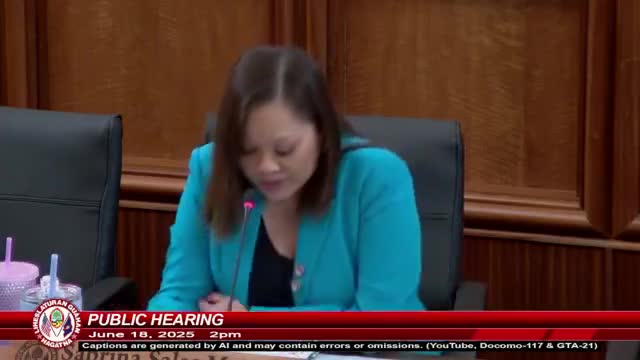
Summary
Guam senators and agency officials on Wednesday heard detailed testimony supporting legislation that would require coordinated early‑childhood development and literacy training for public employees and licensed professionals who work with children from birth to age 8.
Guam senators and agency officials on Wednesday heard detailed testimony supporting legislation that would require coordinated early‑childhood development and literacy training for public employees and licensed professionals who work with children from birth to age 8.
Senator Sabina Perez, author of the bill described in committee as Bill 100‑38, opened the hearing by saying the measure "updates and adds provisions" to strengthen early care and education, promote data sharing, and improve cross‑agency collaboration.
Why it matters: Supporters said the window from birth to age 3 is decisive for language development and that many children in Guam start kindergarten behind their peers. The bill would create a government‑wide training network led by the Department of Public Health and Social Services to align messages and streamline referrals across WIC, home visiting, Head Start, Guam Early Intervention System, Guam Department of Education and the judiciary.
Testimony and main points
Dr. Laura M. Torres Souder, identified herself as testifying in "full support of bill number 100‑38" and told senators that, in her view, "about 70 percent of our children start school already behind due to a lack of language skills development." She said early intervention is crucial and called for the bill to institutionalize early‑childhood priorities across agencies.
Heidi Kanata, chief children's services administrator at the Department of Public Health and Social Services (DPHSS), read Director Teresa C. Areola's written testimony into the record. The DPHSS statement said the legislation would "ensure that every professional interaction involving families with children from birth to 8 years old ... will be guided by consistent research‑based practices in communication, reading, play, and developmental screening." Kanata described a proposed implementation plan that would establish a local trainer network, a centralized registry to track completion of required modules and phased rollouts across agencies.
Bureau of Women's Affairs representative Mrs. Flores said she "lauds the intent" of the bill but suggested funds be directed toward expanding existing community programs and getting books into children's hands rather than spending government dollars primarily on training for government employees. She pointed to Guam Community College (GCC) and the University of Guam (UOG) as existing resources that could be leveraged and highlighted Project Besita y Familia as an accredited home‑visiting program that could be expanded.
Physician Thomas Shea cautioned that some licensed physicians already receive early‑development training in medical school and asked the committee to clarify which categories of providers would be required to complete new training. Senator Perez said she intended for physicians to be included and that bill language could be adjusted.
Committee members pressed DPHSS about the Guam Early Learning Council. Kanata told the committee the council is an advisory arm of DPHSS that is supposed to meet quarterly but "has not met successfully as planned" since March 2024 in part because of turnover among appointed representatives. She said the council would play an "integral part" in implementation and that DPHSS would carry feedback to its director for follow up.
Outcome and next steps
Senator Perez closed by thanking witnesses and said the bill "now moves to its markup phase," a referral the chair confirmed at the hearing. Committee staff said they will take testimony into account and coordinate with DPHSS on council status and implementation details.
Context and unresolved questions
Witnesses and senators repeatedly raised implementation questions the bill does not fully resolve in its current draft: estimated costs and funding sources; which exact job titles and license types would be included in the training mandate; how often continuing education would be required; whether board certification should substitute for training; and whether DPHSS has the staffing capacity to run a centralized trainer registry. Kanata said costs will "depend on how much resources agencies want to leverage" and that leveraging existing professional development structures could reduce work.
The hearing included multiple requests that the markup session clarify (1) the specific list of positions that must complete training, (2) whether board certification or comparable credentials will count as equivalent, (3) how often refresher training would be required, and (4) whether the Guam Early Learning Council's enabling law should be updated to ensure the council can regularly meet and carry out implementation duties.
The committee record shows broad cross‑sector agreement on the bill's goals while leaving budgeting and technical rulemaking to the next phase of the process.