Get Full Government Meeting Transcripts, Videos, & Alerts Forever!
Get email alerts on the State Legislation topic
No spam. Unsubscribe anytime.
Consultants brief Ellensburg council on 2025 state session and preparations for 2026
Summary
A consultant team summarized major outcomes from the 2025 Washington legislative session, described how Ellensburg fared on state capital requests, and urged early planning for the short 2026 session, including targeted capital requests and outreach to legislators.
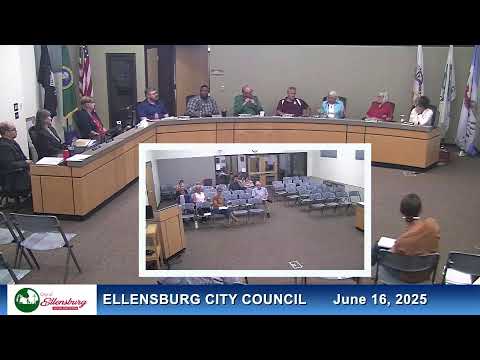
Consultants for the city briefed the Ellensburg City Council on how the 2025 Washington legislative session affected local governments and outlined steps the city can take in advance of the 2026 short session.
Columbia Policy Advisors’ Josh Weese told the council that lawmakers introduced about 1,900 bills in 2025, of which roughly 422 passed, producing an approximate 22% passage rate. He summarized the state operating and capital budgets and how those decisions are likely to shape local funding opportunities and constraints going forward.
Weese gave council members a short review of statewide priorities that intersect with city needs. He noted that the governor used line‑item vetoes when signing the biennial operating budget, and that the transportation budget was constrained by declining gas‑tax receipts. He said the Legislature indexed the gas tax to inflation, which is likely to postpone near‑term debate about switching to non gas‑tax revenue sources such as a road‑usage charge.
On capital spending, Weese said the 2025 capital budget was “healthy” overall and that the average local community project award this year was roughly $578,000. He listed bills of interest to cities that passed, including a public‑safety funding bill that expanded eligible uses beyond traditional law enforcement, a bill clarifying the role of behavioral‑health co‑responders, and a suite of housing‑related bills (lot splitting, mandated unit lot subdivisions, condominium insurance reforms and a harmonization of real‑estate‑excise tax rules) intended to support housing production.
Weese reviewed Ellensburg‑specific efforts. The city had pursued a public facility district authorization that would have allowed sales tax financing for a community field house and had sought capital funds for acquisition of the Pearson Kuchan property through the Floodplains by Design program. He reported that the Thirteenth Legislative District secured many projects in the final capital budget, but that the city’s specific requests were not funded in 2025. He said the city’s Climate Commitment Act–funded decarbonization plan for the natural‑gas utility remained funded, and staff reported that work on that plan is ongoing.
Looking ahead to the 2026 short session, Weese said the session will begin Jan. 12 and run 60 days. Although 2026 is not a general election year, he noted a number of special elections this fall for appointed legislative seats that could affect the session’s tenor. With an uncertain revenue picture and three upcoming state revenue forecasts, he recommended that the city: focus on capital‑budget requests that are well scoped by October; increase briefings for the new governor’s office and agency leadership; and do early outreach to the city’s legislators and legislative leaders.
Why this matters: short sessions are compact and prioritize either budget adjustments or capital projects with clear, legislator‑backed requests. For smaller cities like Ellensburg, timing, clear scope and legislator buy‑in increase the chance that a capital request will be included when limited dollars are available.
Weese and colleagues answered council questions on project prioritization, grant competitiveness and the state revenue forecast timetable. Council members pressed for clarity on how local priorities are assembled and how district legislators divide local community project allocations. Weese explained that some capital funding streams are agency‑ranked competitive grants, while the local community project process lets legislators allocate a limited amount of funding within their districts.
The presentation concluded with counsel from the consultants that Ellensburg prepare prioritized capital requests and conduct legislator outreach this fall so that projects are competitive when short‑session and supplemental capital opportunities arise.