Get Full Government Meeting Transcripts, Videos, & Alerts Forever!
Get email alerts on the Short Term Rentals topic
No spam. Unsubscribe anytime.
Normal council approves ban on new short-term rentals in single-family zones, adds owner-occupied exception
Summary
After hours of public comment and council debate, the Normal Town Council on June 16 approved an ordinance prohibiting new short-term rentals (STRs) in R‑1 and R‑2 single-family zoning districts, phasing out existing nonconforming STRs over five years and adding an owner-occupied exception with specific documentation requirements.
The Normal Town Council on June 16 adopted an ordinance that bars new short-term residential rentals in R‑1 and R‑2 single-family zoning districts, phases out most existing short-term rentals in those districts over a five-year amortization period and creates an exception for owner-occupied properties that meet a new residency test.
Council-approved language requires an STR in R‑1 or R‑2 to be the owner occupant’s primary residence to qualify for a license; primary residence must be demonstrated by residing in the dwelling nine of the past 12 months or intending to reside nine of the next 12 months with two supporting documents such as utility bills, vehicle registration, deed or proof of homestead exemption. Legal counsel read the proposed exception into the record: "Notwithstanding subsection a, a property located in an r 1 or r 2 zoning district may be operated as a short term residential rental unit if that property is the primary residence of the owner occupant of the property." The ordinance includes an appeals path for owners who claim extraordinary investment that cannot be recouped within the amortization period.
The ordinance responds to issues staff and some residents described as recurring: complaints about frequent turnover of guests, parking and event-related impacts, and a concern that public-facing lodging-style businesses are not compatible with single-family residential zoning. Planning and Zoning Director Mercy Davison told the council the town originally required STR registration in 2018 and by 2024 had started receiving “an increasing number of complaints from normal residents.” She said the town found 66 STRs registered since the moratorium, with about 49 in R‑1 and R‑2 and 42 distinct owners; roughly 46 percent of owners live in Normal or Bloomington.
Public comment was strongly divided. Tracy Pat Kunis, identified as president of the Mint Illinois Realtors Association, urged the council to avoid a broad ban: "We oppose the ordinance because of its effective ban on short term rentals in R 1 and R 2 zoning districts." Several resident speakers described neighborhood disruptions; Thomas Collins said of a nearby STR, "I have the right to fall safe in my home," and recounted what he described as heavy vehicle traffic and a police report after an incident. Hosts and small-business owners urged the council to preserve responsible, local operators. Local host Andrew Batty told the council, "We're not absentee landlords. We are at our property every day, checking in, maintaining the space, and making sure everything is secure and respectful of the neighborhood." Other commenters and council members criticized the staff report as incomplete or rushed and called for more data.
Councilmembers debated competing goals stated in earlier work sessions: preserving neighborhood character, protecting housing stock (particularly more affordable housing), and preserving the integrity of zoning that disfavors public-facing businesses in single-family districts. Staff said their recommended ban best met those three goals; councilmembers who opposed the ordinance said the evidence tying STRs to the broader housing-cost trends was weak and that more targeted regulation (for example, separation distances, stricter licensing and inspection, or neighborhood sign-off) had not been fully explored.
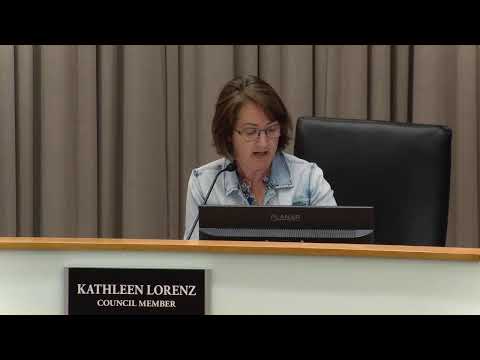
Councilmember McCarthy offered the amendment creating the owner-occupancy exception. The amendment passed on roll call earlier in the meeting. At final passage the ordinance, as amended, passed on roll call 5–2 (Yes: Roberge, Smith, McCarthy, Byers, Coos; No: Preston, Lorenz). Mayor Coos announced, "The item is approved."
Under the ordinance the owner-occupied exemption takes effect when the ordinance becomes effective; currently operating STRs in R‑1 and R‑2 that are not owner occupied may continue to operate for up to five years under an amortization schedule, or convert to long-term rentals or other uses sooner. The town wrote that there is an appeals option for owners who can document extraordinary investments that cannot be recovered during the five-year period.
Council members and staff said the ordinance begins a longer policy conversation rather than an endpoint. Several council members urged using the five-year period to track complaints more consistently, develop enforcement procedures and revisit distance, licensing and inspection options.
The vote follows months of work-session discussion and a moratorium that led to registration: staff said 66 short-term rentals ultimately registered after the moratorium; of those, 49 are in R‑1/R‑2, 13 in R‑3 and four in commercial districts. Staff reported the average purchase price for STR properties purchased after 2019 was roughly $173,000 and that the average value of permitted work on STR properties was about $15,000, findings staff used to argue these properties are not predominantly large rehabilitations of blighted housing.
The council did not adopt alternative approaches such as a saturation cap, mandatory annual inspections, or a special‑use pathway for STRs in single-family zones; staff said those approaches would either grandfather the current inventory or otherwise fail to address running a public-facing lodging business in single-family districts. Councilmembers who opposed the ordinance said other municipalities in central Illinois regulate STRs without an outright ban and urged additional analysis and stakeholder engagement.
The ordinance text, as read into the record by legal counsel, includes the owner-occupancy definition (9 of 12 months) and an ownership threshold (owner occupant may be a natural person who holds title or an entity in which the individual owns at least 25 percent).
The council asked staff to return with implementation details and enforcement guidance during the five-year amortization period, and several members said they expect further refinements before full implementation.