Get Full Government Meeting Transcripts, Videos, & Alerts Forever!
Get email alerts on the Opioid Settlement Funding topic
No spam. Unsubscribe anytime.
Burke County advisory committee launches, directs staff to develop naloxone, peer-navigation and post-overdose response models
Summary
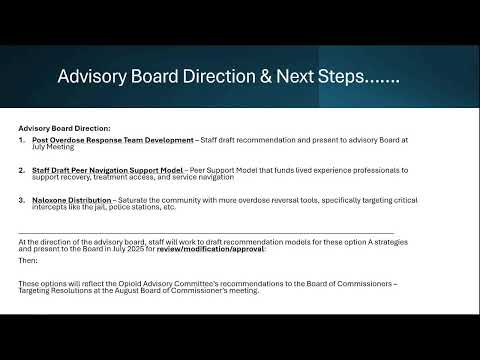
The newly formed Burke County Opioid Advisory Committee voted to adopt bylaws and a bimonthly meeting schedule, elected officers and asked staff to return in July with funding models for three short-term strategies: naloxone distribution, peer navigation and a formal post-overdose response team.
Burke County’s newly convened Opioid Advisory Committee met in June to adopt bylaws, elect officers and set substantive priorities for spending opioid settlement funds, directing staff to return in July with funding models for three near-term strategies: expanded naloxone distribution, peer navigation and a formal post‑overdose response team.
The committee voted to approve its agenda and bylaws, elected Jeff Britton chair, Katie Samuels as secretary and Dr. Frank as vice chair, and adopted a bimonthly meeting schedule starting in July on the third Tuesday at 3:30 p.m. County staff and advisory members then spent the bulk of the meeting reviewing data and possible short‑ and long‑term investments.
County Manager (name not specified) told the committee the county has about $25 million expected to flow over roughly 15 years from opioid settlement funds and that recent national settlements (Kroger and Purdue) are increasing the county’s allocation. “We’re talking close to $25,000,000 over the next 15 years,” the manager said, and framed the advisory board’s job as translating those dollars into measurable reductions in overdose deaths and stronger recovery pathways.
Dr. Katie Samuels, returning to lead the county’s settlement work, briefed members on the North Carolina memorandum of agreement (MOA) that governs allowable uses and explained the MOA’s Option A (strategies the board can fund immediately) and Option B (longer‑term strategies that require unlocking Option B). “Option A items, we can do right away, at the will of the board of commissioners,” Samuels said. She added that prevention strategies are predominantly in Option B and require completing a strategic‑planning process to unlock them.
Meeting presenters reviewed three years of local EMS overdose dispatch data (January 2022 onward). The county manager described spatial patterns concentrated near I‑40 and multiple repeat calls to the same addresses; he noted a large cluster inside correctional facilities and identified a mobile‑home park on Highway 70 with multiple recent overdose calls. He also summarized time‑of‑day and demographic trends: most EMS overdose calls occur between about 2 p.m. and 8 p.m., and the majority involve men aged roughly 25–40.
The manager and staff highlighted a county naloxone distribution effort that distributed large quantities of Narcan to schools, first responders and community organizations. “Even though our number of overdoses have been flat, the reversal of those overdoses have been significant. We’ve seen about a 50 percent reduction at this point in deaths,” the manager said, citing a drop from about four deaths per month in April 2022 to a bit more than two per month most recently.
Staff described currently funded strategies and near‑term proposals: collaborative strategic planning (with consultant CEG), a peer support network called Peers Partnering for Excellence, naloxone distribution, funding a recovery treatment court through Cognitive Connection through December 2026, and an RFP released to solicit Option A project proposals from local providers. Staff also said Burke County has access to a roughly $6,250,000 brick‑and‑mortar grant held by a behavioral‑health partner that could underwrite facility development.
Committee members and attendees favored building a formal post‑overdose response (POUR) team that would coordinate with EMS and peers to provide rapid follow‑up after an overdose and make warm handoffs into treatment. Tina, identified in discussion as the county’s community paramedic, currently does post‑overdose follow‑ups but committee members said the role needs to be a staffed, 24/7 team rather than a single person performing those duties in addition to other community‑paramedicine tasks.
Members also discussed embedding peer support specialists in emergency departments, jail programming (including Vivitrol initiation in the county jail), harm‑reduction outreach (including syringe‑services in other counties), and early‑intervention/school‑based curricula as potential prevention or early‑intervention pathways. Several members noted that some peer services are Medicaid billable but that post‑overdose response activities may not be fully billable for uninsured people; staff flagged sustainability concerns and the need to model long‑term funding.
After discussion, Dr. Frank moved and a member seconded a motion directing staff to develop funding models for naloxone distribution, peer navigation and a formal post‑overdose response team and return proposals at the July meeting for possible referral to the Board of Commissioners. The motion passed by voice vote.
The committee closed with direction for staff to bring data, draft budgets and implementation options to the July meeting so members can prioritize Option A recommendations and continue planning work toward unlocking Option B strategies.