Get Full Government Meeting Transcripts, Videos, & Alerts Forever!
Get email alerts on the General Government Operations And Appropriations topic
No spam. Unsubscribe anytime.
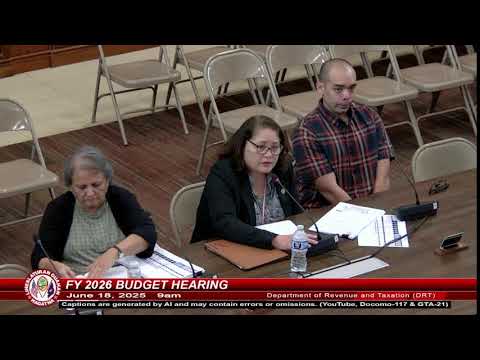
Finance committee hears status-quo FY2026 budget request for Department of Revenue and Taxation
Summary
The Committee on Finance and Government Operations held a public hearing June 18 on Bill No. 44-38 COR, the governor-requested appropriation bill for operations of the executive branch for the fiscal year ending Sept. 30, 2026.
The Committee on Finance and Government Operations held a public hearing June 18 on Bill No. 44-38 COR, the governor-requested appropriation bill for operations of the executive branch for the fiscal year ending Sept. 30, 2026. Department of Revenue and Taxation Director Marie Lizama told the committee her agency is presenting a status-quo request while noting staffing gaps and ongoing modernization needs.
Lizama said the department's funding request for FY2026 is the same as FY2025 and asked that “a provision for DRT to use any unexpended FY 2025 funds be included in the budget law.” She outlined recent agency work — reduction of limited-term appointments to 16, an internship agreement with the University of Guam College of Business and Public Administration, and continuing efforts to issue tax refunds within an average of six weeks from filing.
Why it matters: senators pressed Lizama on areas where DRT says it lacks capacity. The Business Privilege Tax (BPT) branch, which the department described as chronically understaffed, was a central topic. Lizama said the BPT branch currently has only two full‑time employees and is supplemented by staff from other branches. Michelle Santos, banking and insurance commissioner and acting deputy director, said retirements and no‑shows for hire offers have contributed to the vacancy problem.
Committee members sought specifics on recruitment and retention. Senator Christopher M. Duenas, chair of the committee, cautioned agencies not to treat carryover as new revenue and asked for clearer accounting of vacant but funded positions; he also asked Lizama to provide a calculation of the savings from positions the department will not request in FY2026. Lizama said she would calculate and follow up.
Operational issues: DRT described several implementation and procurement challenges that affect services. Lizama and staff reported a vendor outage and an expired certificate disrupted the driver's license system earlier in the year, prompting temporary weekend openings to handle overflow. The department is drafting a new procurement for a vendor and said one jurisdiction (Arizona) has offered to share its system code; DRT noted maintenance costs would still apply.
Tobacco stamps and enforcement: Lizama reported delivery of tobacco stamps (phase 1) and said wholesalers are completing equipment (phase 2) to apply stamps; she and senators said stamp implementation should simplify bonded‑warehouse inspections. The department also reported eight investigations of bed‑and‑breakfast operations that resulted in $5,000 in fines collected so far.
Legal and administrative capacity: Lizama described the agency's in‑house legal team and said attorneys handle procurement, regulatory and litigation work. Senators asked whether the three attorneys are necessary; Lizama said each has distinct duties (principal income tax attorney, consumer/regulatory attorney, litigator) and that none holds a specialized tax LLM. The committee pressed on vendor contract continuity and noted some vendors were asked to pursue government claims when contracts were not properly in place.
Staffing and training: Lizama emphasized recruitment efforts including the UOG internship program and use of workforce programs (WorkKeys, CWEB). Management analyst Miguel Espiritu confirmed continuous open recruitment for a BPT supervisor but said applicant pools remain small. Committee members suggested targeted pay or above‑step recruitment and additional training (including bringing federal instructors to Guam) to improve retention.
Financial controls and reporting: Senators asked about special funds and lapses. Lizama and staff said a discrepancy exists between system balances for prior fiscal years (FY2024 and earlier) and current records due to migration issues between legacy and new financial systems; management analyst Miguel Espiritu said some prior‑year funds required DOA overrides for expenditure. The committee asked DRT to reconcile and report back. DRT staff said they will provide follow‑up data requested by senators.
No final vote: the hearing was for testimony and questions; no formal committee action occurred. Chair Duenas closed the hearing and said the committee will accept written testimony for seven calendar days after the hearing.
What to watch next: DRT's follow‑up on (1) a reconciled accounting of unexpended FY2025/FY2024 funds and lapses, (2) recruitment and planned use of vacant‑but‑funded positions, (3) progress on the driver's license procurement and vendor transition, and (4) completion of tobacco stamp implementation with wholesalers.
(Quotes and attributions are from the June 18, 2025 public hearing of the Committee on Finance and Government Operations.)