Get Full Government Meeting Transcripts, Videos, & Alerts Forever!
Get email alerts on the School Governance Goals topic
No spam. Unsubscribe anytime.
San Marino Unified board refines 2025–26 goals, prioritizing safety audits, fiscal transparency and career readiness
Summary
At a strategy-planning session, the San Marino Unified School District Board of Education agreed to carry over and revise key district goals for 2025–26, emphasizing a first-step evaluation of campus safety, clearer fiscal transparency and expanded career and internship pathways for students.
SAN MARINO, Calif. — At a strategy-planning session on the morning of the meeting, the San Marino Unified School District Board of Education discussed and refined draft goals for the 2025–26 school year, agreeing to keep safety and fiscal stability as primary priorities while adding emphasis on community understanding of district finances and student preparation for postgraduation pathways.
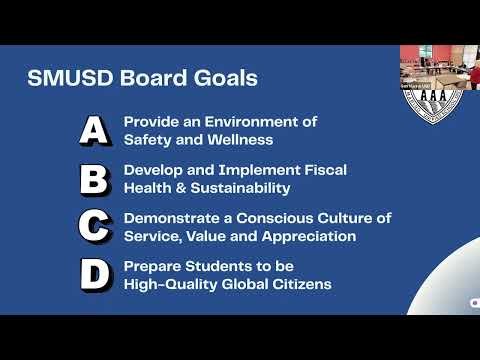
The discussion centered on four draft goals carried over from the prior year: A) provide an environment of safety and wellness; B) develop and implement fiscal health and sustainability; C) demonstrate a culture of service, value and appreciation; and D) prepare students to be high-quality global citizens. Board members and staff focused on wording changes and how to make each goal measurable and actionable.
Dr. Deltoro, an executive-team presenter for the session, urged keeping students at the center of decisions and described the exercise as a foundation for the board's work. “If every decision that we make is in the interest of the students we serve, who can criticize that?” Dr. Deltoro said. Board member Gil emphasized the district’s focus on students: “Every single child,” he said.
On safety and wellness (Goal A), the board agreed to prioritize evaluation before new investments. The group proposed a cycle of audits, followed by targeted enhancements: regular safety inspections, reviews of classroom chemical storage through the district’s JPA-contracted risk-management processes, expanded use of wellness-center usage data and surveys to measure counseling effectiveness, and staff crisis-response training. The board discussed using bond proceeds from Measure M for physical-campus safety improvements such as additional surveillance coverage and lock-down upgrades; specific allocations were not specified at the meeting.
The board also stressed attention to equity and “special populations” when planning safety work, noting that emergency and evacuation protocols must address students with limited English proficiency, hearing impairments and other access needs. Staff were directed to present an evaluation framework and an action plan that sequences assessment, enhancement and re-evaluation.
On fiscal health and sustainability (Goal B), trustees said the district has met near-term fiscal-health targets and wanted the next step to be clearer public understanding and access. Members agreed to change language from “develop and implement” to maintain/elevate fiscal health with an emphasis on transparency and community education. The board discussed dashboards and ClearGov-style tools and proposed outreach such as budget coffees and community forums to explain the district’s financial landscape in plain language; no new funding actions were adopted at the meeting.
Trustees directed staff to include measurable steps under the fiscal goal: improve ease of access to fiscal reports, promote community understanding through targeted education, and continue evaluating program sustainability and new revenue opportunities (grants, revenue streams and ADA-focused strategies). The board requested that proposed wording and an implementation plan be provided in a future staff report.
Under the goal on culture and appreciation (Goal C), participants noted ongoing employee-recognition programs and said the district should continue integrating service-oriented practices across departments so that responsiveness is not only the superintendent’s responsibility but a districtwide expectation. The board suggested including public-facing communication work led by the district’s communications team to raise awareness of programs and accomplishments.
For student preparation (Goal D), members broadened the emphasis beyond the phrase “global citizen” to include career readiness, ethical and character development, and integrating new topics such as artificial intelligence into existing curriculum rather than treating them as stand-alone offerings. Trustees discussed expansion of career and technical education (CTE) pathways, stronger partnerships with regional postsecondary providers (including Pasadena City College), and a proposed job/internship board or portal so students can access internships, part‑time work and community opportunities; district counsel and staff were asked to research liability and implementation details.
No new ordinances, contracts or budget resolutions were adopted during the meeting. The board took two formal procedural actions on the record: the approval of the meeting agenda and a motion to adjourn at the session’s close. The board asked staff to return with revised goal language and concrete next steps for safety audits, fiscal transparency tools and proposed career-readiness offerings.
The session included regular agenda procedures (roll call, pledge of allegiance and public‑comment instructions). Public-comment submission windows and procedures were read into the record; the district advised that comments submitted online for the public comment period on June 10–9, 2025 would be provided to the board but not read at the meeting.
Staff follow-ups the board requested include a written evaluation framework for safety audits, a timeline and cost estimate for any Measure M–funded safety upgrades, a proposal for financial‑transparency communications (dashboards and community forums), and a legal review and implementation plan for a student internship/job board.
Votes at a glance
- Approval of meeting agenda — motion and second taken; roll call recorded as part of the meeting record (not all individual votes were attributable in the transcript). (Provenance: agenda-approval excerpt.)
- Adjourn meeting — motion seconded; votes recorded on the transcript as yes from board members Lam, Ryan, Gill and Chen; motion carried. (Provenance: adjournment excerpt.)