Get Full Government Meeting Transcripts, Videos, & Alerts Forever!
Get email alerts on the Sea Turtle Lighting topic
No spam. Unsubscribe anytime.
Planning board reviews FWC model lighting guidance for sea turtle protection; staff recommends voluntary technical guidance because of SB 180
Summary
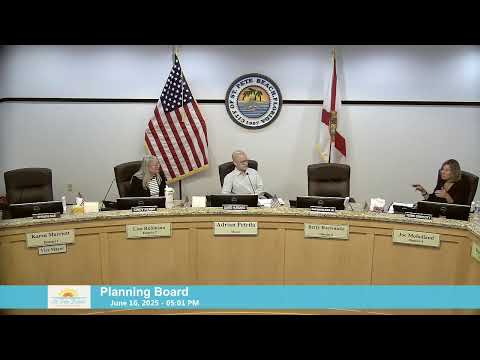
Planning Board members on June 16 discussed adopting the Fish and Wildlife Conservation Commission model lighting standards for marine turtle protection; staff recommended adopting the model as voluntary technical guidance in light of Senate Bill 180.
Planning Board members on June 16 discussed adopting the Fish and Wildlife Conservation Commission (FWC) model lighting ordinance for marine turtle protection. Gil Martinez, senior planner, and Pete Duerer, code enforcement manager, presented the proposal and described enforcement tools and next steps.
Martinez said the city’s current sea turtle lighting rules are in Division 44 of the Land Development Code and dated to 2007. He told the board the FWC model (2020) provides science‑based, pre‑vetted technical standards—bulbs, fixtures, transmittance criteria and testing protocols—that could make local compliance more objective. Martinez said staff proposes using the model as a voluntary technical guide because of legal constraints in Senate Bill 180.
Attorney Brooks and staff explained that SB 180 limits municipalities’ ability to adopt more restrictive land‑use or development standards; as a result, the city can retain existing code enforcement and also provide the FWC model as voluntary technical guidance or a resolution to help property owners identify compliant fixtures and bulbs. Martinez said that approach would not remove staff’s ability to enforce the existing code.
Pete Duerer described the city’s existing enforcement practice. He said code enforcement uses a card and lens—similar to the test described in the FWC materials—to determine whether beachfront lighting is visible from the beach and that staff has cited properties under the current code, including a repeat violator who was fined by a special magistrate (Duerer said the penalty reached $500 per day in that matter).
Board members asked technical questions about measurements and enforcement. Staff noted that assessing existing development sometimes requires instruments such as light meters or spectrometers and that the FWC list of vetted bulbs and fixtures can reduce reliance on subjective local evaluation. Martinez said next steps are to solicit planning board input, consult the Beach Stewardship Committee and technical experts, return a draft ordinance to the planning board, and then send a proposal to the City Commission for readings.
No formal ordinance change was adopted at the planning‑board meeting; staff recommended the voluntary technical guidance approach to balance turtle‑protection goals and the current statutory constraints.