Get Full Government Meeting Transcripts, Videos, & Alerts Forever!
Get email alerts on the Community Redevelopment Agency topic
No spam. Unsubscribe anytime.
St. Pete Beach planning board reviews Community Redevelopment Agency proposal focused on resiliency; staff to present finding of necessity to commission July 8
Summary
City staff introduced a proposal to create a Community Redevelopment Agency (CRA) that would use tax increment financing (TIF) to pay for resiliency and infrastructure projects; staff plans to seek a finding of necessity from the City Commission on July 8 and to work with Pinellas County and university partners on technical analysis.
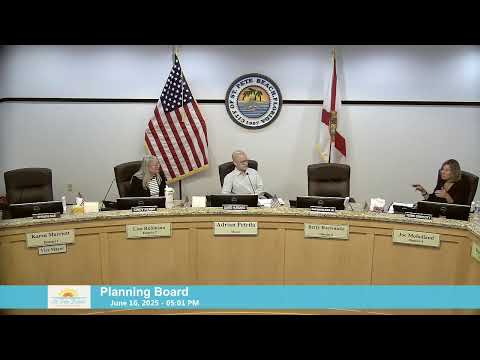
The Planning Board of St. Pete Beach heard a presentation June 16 from Gil Martinez, senior planner with the Community Development Department, on creating a Community Redevelopment Agency that would use tax increment financing to fund infrastructure and resiliency projects.
Martinez told the board that a CRA would require a finding of necessity demonstrating that an area meets the statutory definition of blight under Florida Statute 163, a community redevelopment plan aligned with the city’s comprehensive plan, and—if county revenues are affected—interlocal agreements with Pinellas County. He said staff is scheduled to seek the commission’s consideration of a finding of necessity on July 8.
A CRA funds projects primarily through TIF, Martinez said: the assessed value within the designated area is fixed at a base year, and future increases in ad valorem revenue above that baseline—the increment—can be directed to the CRA for reinvestment in projects within the CRA boundary. He said a CRA can enter contracts, acquire and dispose of property, apply for grants, and issue bonds for capital improvements.
Board members asked questions about why earlier efforts in St. Pete Beach did not proceed. Martinez said research found a 2005 finding of necessity that stalled, in part because the county was hesitant to consider CRAs for barrier island communities at that time; he said staff could not confirm details about the 2013 effort. A board member noted that Hurricanes recently damaged many properties and said some neighborhoods “would probably be declared a blight at this point,” adding concern about property tax implications.
Martinez and other staff clarified technical points raised by board members: TIF applies to ad valorem tax revenue distribution and does not directly raise a property owner’s tax bill; the “freeze” is in distribution, not a freeze of an owner’s assessed value. He said Pinellas County has revised its delegation criteria and now expects new CRAs to start with a lower county participation rate—“start at 50 and then you kind of work your way up”—instead of the near-95% participation the board has seen historically in some jurisdictions. Staff also said baselines can be reset in some cases if the original base year proves disadvantageous.
Martinez said staff is pursuing technical assistance with the University of Florida Institute for Built Environment Resilience (FIBER) to help develop the finding of necessity and to visualize resiliency needs and grant-ready projects. He told the board the finding-of-necessity scope of services has been received and will be taken to the commission.
Board members pressed for comparisons to other coastal communities and asked staff to report back on whether other jurisdictions adopted CRAs after storm damage. Martinez said he would research municipal examples and return with a report to the board the following month.
The discussion identified dependencies and next steps—the board’s review would continue as staff develops the finding of necessity and the community redevelopment plan and as the commission considers interlocal agreements with the county. No formal action to establish a CRA was taken at the planning-board meeting.