Get Full Government Meeting Transcripts, Videos, & Alerts Forever!
Get email alerts on the Cultural Access Program topic
No spam. Unsubscribe anytime.
Vancouver staff outline Cultural Access program and timeline after council-authorized 0.1% sales tax began collecting
Summary
City staff and partners presented the Cultural Access Program framework on May 19, describing ordinance M4480, the program's legislative intent, an estimated $7 million annual revenue, and a schedule for a policy draft due July 1 and final adoption by Oct. 1.
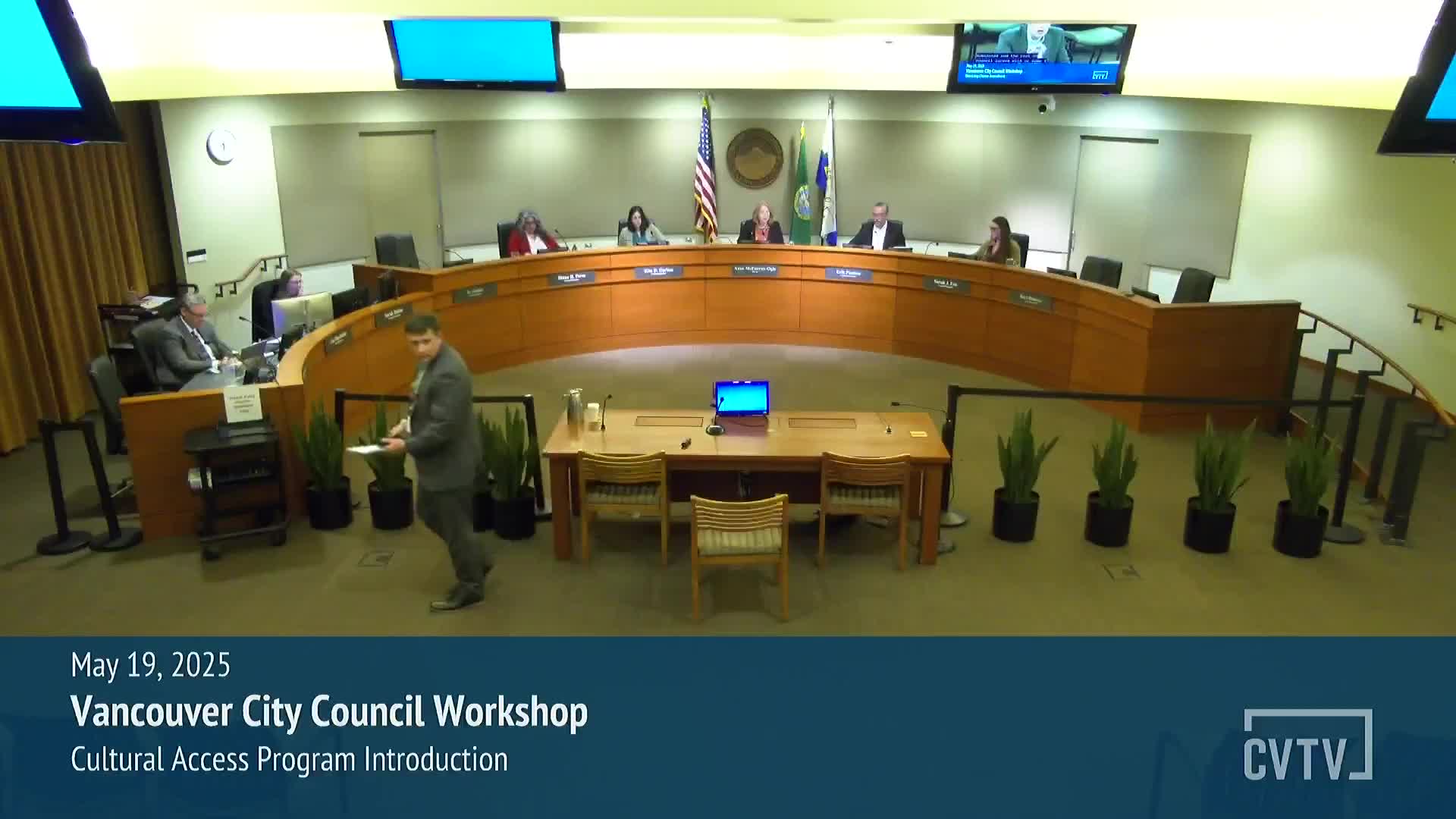
City staff and community partners briefed the Vancouver City Council on Monday, May 19, on plans to implement the city's new Cultural Access Program, created by ordinance M4480 and funded by a 0.1% sales tax the council authorized last year. City presenters said collections began April 1 and that the tax could provide up to $7 million annually for seven years.
"The ordinance empowers the city to use the state's cultural access revenue tool to collect a new 1 tenth of 1% sales tax that will be invested in arts, culture, heritage, and science in Vancouver," said Linda Reed, a Culture, Arts and Heritage Commissioner during the workshop.
Nut graf: The council adopted ordinance M4480 in December 2024 to use a state-authorized cultural access sales-tax tool. Staff and a task force are developing a city policy, draft due July 1 and final policy required by ordinance by Oct. 1, to guide grants to 501(c)(3) cultural organizations, K–12 educational engagement, and equity-focused outreach; the city intends to open the grant program in 2026.
What the ordinance and state law allow
Staff said the state-authorized Cultural Access Program (legislation creating the tool was passed in 2015) permits local jurisdictions to add up to 0.1% to the sales tax to fund grants for eligible nonprofit cultural organizations. Linda Reed and Manny Kualin, executive director of Inspire Washington, described the statute's legislative intent: expand public access to cultural programs, strengthen cultural education for K–12 students, and support economic activity tied to arts and culture. Eligibility is limited to 501(c)(3) nonprofits or organizations with eligible fiscal sponsors; state law excludes direct funding to city governments and state agencies.
Key numbers and timeline presented
Staff and commissioners said the tax is estimated to generate up to $7,000,000 per year for seven years; collections began April 1. Per the ordinance, the Culture, Arts and Heritage Commission must submit a first draft policy to council by July 1 and the final policy must be adopted by Oct. 1. Staff presented a proposed council review schedule: a follow-up workshop June 16, draft submission June 30/July 1, council feedback Aug. 4 and Aug. 25, first reading Sept. 11 and second reading and adoption Sept. 15, with grant solicitations anticipated to open in 2026.
Questions from council and staff responses
Council members pressed for clarity on several points: whether "science" should be explicitly included in local committee naming and membership (the statute includes science among eligible categories); administrative and evaluation costs; the percent of revenue that can or should be reserved for administration and specific uses such as school transportation; and how to balance broad versus focused investments (many small grants vs. fewer larger awards or capital projects).
On administration, staff and the external presenter noted that state law permits up to 10% of revenue for administrative costs but programs vary; some local programs set aside a portion for start-up and evaluation. Councilors asked staff to present options for allocation (for example, operating support, capital investment, education/transportation set-asides) and to identify strategies that avoid long-term dependency by organizations on the new fund.
School and equity priorities
Inspire Washington and staff emphasized the statutory requirement to expand cultural education for public school students and recommended that Vancouver coordinate with Evergreen and Vancouver public schools. Staff said Tacoma and Olympia use dedicated school-transportation or school-program set-asides (Tacoma reserves at least 8% of revenue for school transportation in its program) as examples; the Vancouver task force will recommend whether a similar set-aside is appropriate here.
Governance and partnerships
The Culture, Arts and Heritage Commission will oversee the program after council adopts the policy. Staff and commissioners said they are collecting best practices from Tacoma, Olympia and King County and considering partnerships with local entities such as the Community Foundation of Southwest Washington to help with outreach and application evaluation, particularly for smaller cultural organizations and rural-serving groups.
Formal action
No ordinance or policy was adopted at the May 19 workshop. The council provided feedback to staff and directed the task force to continue drafting the policy framework. Staff confirmed the schedule required by the ordinance (draft by July 1, final policy by Oct. 1) and said they will return with a draft proposal for council review.
What to watch next
Council requested that the task force present allocation options (administration percentage, operating vs. capital allocations, school-transportation set-aside, evaluation metrics), options to support both small and larger organizations, and measures for program evaluation. Staff will present a draft proposal to council on or before July 1 and will return for additional review in August and final readings in September.
Ending
Council members broadly supported the program goals—expanded access to cultural programs and stronger arts education—but pressed staff for concrete allocation scenarios, evaluation metrics, and partnerships to ensure equitable outreach and administrative capacity before the policy is finalized.