Get Full Government Meeting Transcripts, Videos, & Alerts Forever!
Get email alerts on the Districting topic
No spam. Unsubscribe anytime.
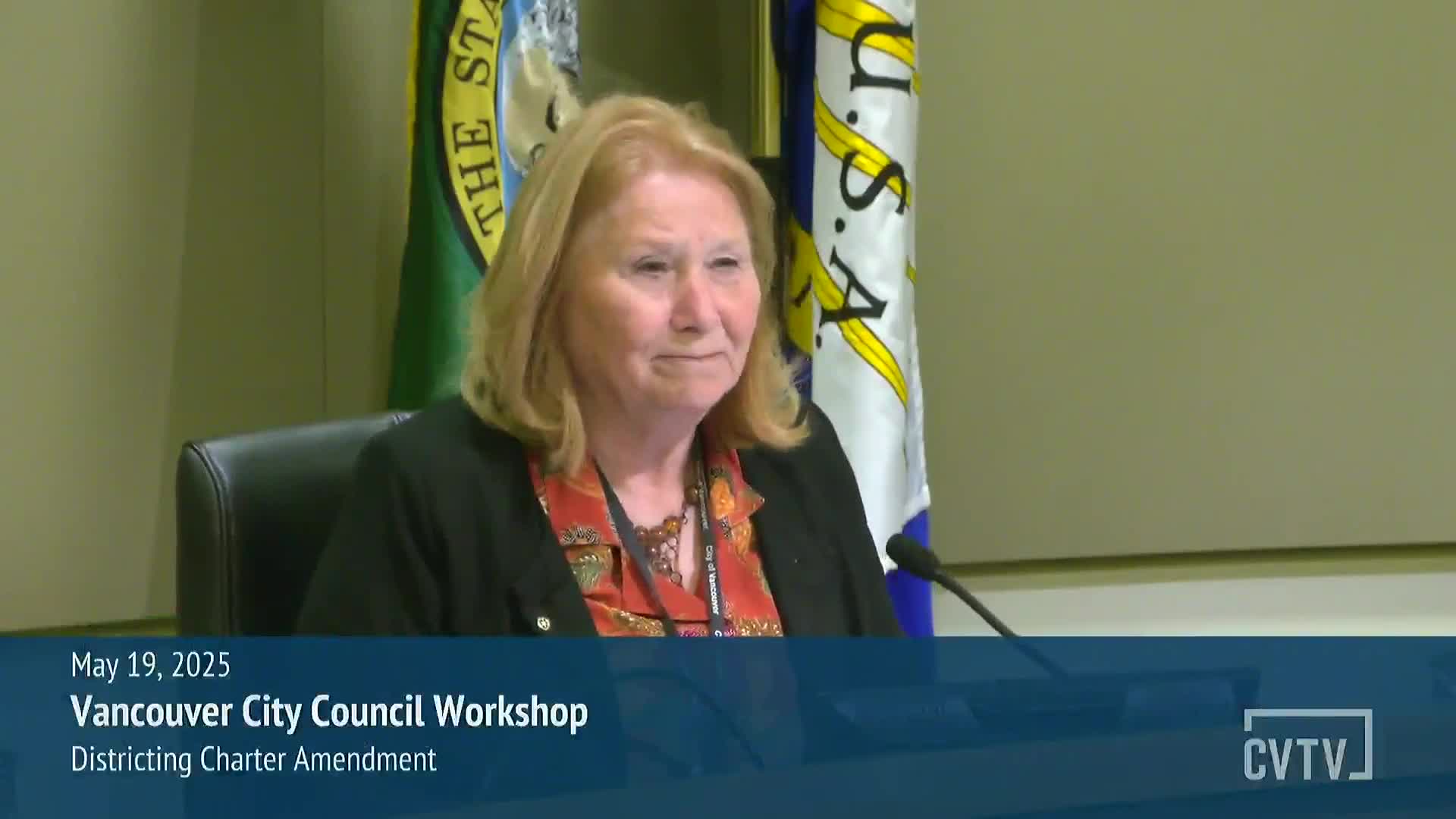
Majority of Vancouver council signals support for four-district, two at-large hybrid; directs subcommittee to refine ballot language
Summary
A majority of the Vancouver City Council on Monday, May 19, signaled support for a hybrid districting plan that would create four geographic districts with one councilmember elected from each district and two additional at-large councilmembers, and directed staff and the districting subcommittee to refine the proposal for council consideration and possible placement on the November 2025 ballot.
A majority of the Vancouver City Council on Monday, May 19, signaled support for a hybrid districting plan that would create four geographic districts with one councilmember elected from each district and two additional at-large councilmembers, and directed staff and the districting subcommittee to refine the proposal for council consideration and possible placement on the November 2025 ballot.
The direction came during a workshop discussion of five options the districting subcommittee and city staff drafted after earlier charter-review work. "Proposal B…this is the most recent…this would have 4 districts with 1 council member representing each district, and then you'd have, 2 additional council members who'll be serving as at large members of the council," said Aaron Landy, a city staff member who presented the proposals.
Why it matters: changing from at-large to district-based elections would alter how Vancouver voters choose councilmembers, could change campaign scale and costs for candidates, and would require creation of a districting commission or other process to draw boundaries. Several council members said they want a plan on the ballot this year; others urged more time to resolve details such as term staggering, how to transition current members into a districted structure, and who appoints the districting commission.
What the proposals said
Proposal A: Revisit a 2019 charter-review recommendation and create three districts with two councilmembers representing each district. Candidates would have to live in a district; nominees would be chosen in district primaries, then the two nominees from each district would be voted on citywide in the general election. The 2019 proposal called for a districting commission made up of citizens and was set to be effective for the 2027 general election.
Proposal B: The plan the council largely favored would create four districts with one councilmember elected from each district, plus two at-large seats and an at-large mayor. "Proposal B keeps everything within just the district for both the primary and the general election," Landy said, distinguishing it from Proposal A.
Proposal C: An advisory question to voters in 2025 asking whether council should appoint a districting committee to develop a 2026 ballot measure.
Proposal D: A council-appointed districting committee beginning summer 2025 to develop a 2026 ballot initiative, with the committee conducting community engagement and drafting the measure.
Proposal E: A council-led community education and engagement process to develop a 2026 ballot measure; the council could combine districting with other reforms such as term limits or public financing during that process.
Council reactions and next steps
Council members gave individual rankings of their top choices during the workshop. Councilor Fox said her first choice was Proposal B and second was Proposal A. Several other councilmembers likewise named Proposal B as their top preference; one councilmember said E was their top choice. The mayor summarized that a majority of the council favored Proposal B and asked the districting subcommittee to "go back in and take a look at B and try to answer some of the questions that have come up tonight." Aaron Landy told council staff could prepare a resolution and draft ballot language quickly if council provided directional guidance.
Unresolved details noted in discussion included whether two representatives for a district (proposal A) would serve staggered terms; how to transition existing council members if many incumbents live in the same new district; whether the districting commission appointments would be made by the full council and what criteria would govern selection; and whether district-elected councilmembers would be expected to prioritize citywide issues when making budget and public-safety decisions.
Councilors repeatedly cautioned that district-elected members must still consider citywide responsibilities: "Those 4 individuals are going to need to understand that they represent the entire city when they're talking about budgets and law enforcement decisions…" the mayor said.
Formal action
No ordinance or charter amendment was adopted at the workshop. Instead, council provided direction: staff and the districting subcommittee were asked to refine Proposal B and return specific language, timing, and implementation details (including commission formation and term staggering) for an upcoming consent-item resolution. Council discussed placing a measure on the November 2025 ballot but acknowledged the schedule is tight and that practical constraints could push implementation to 2029 if mapping and filing deadlines cannot be met.
What to watch next
Staff said they would return to council in early June with refined language and a recommended process and that a final resolution could be brought to the council for placement on the November 2025 ballot if the subcommittee and staff can meet county ballot deadlines. The districting subcommittee will prepare answers on commission appointment process, staging, and the transition plan for sitting councilmembers.
Ending
Councilmembers emphasized the decision reflects years of deliberation and public input and asked colleagues who are not on the districting subcommittee to share specific points they want the subcommittee to consider. The council did not take a formal vote; it directed staff to prepare materials for a future agenda item and to work with the city attorney and the districting subcommittee to draft proposed ballot language.