Get Full Government Meeting Transcripts, Videos, & Alerts Forever!
Get email alerts on the Transportation Emissions Ev topic
No spam. Unsubscribe anytime.
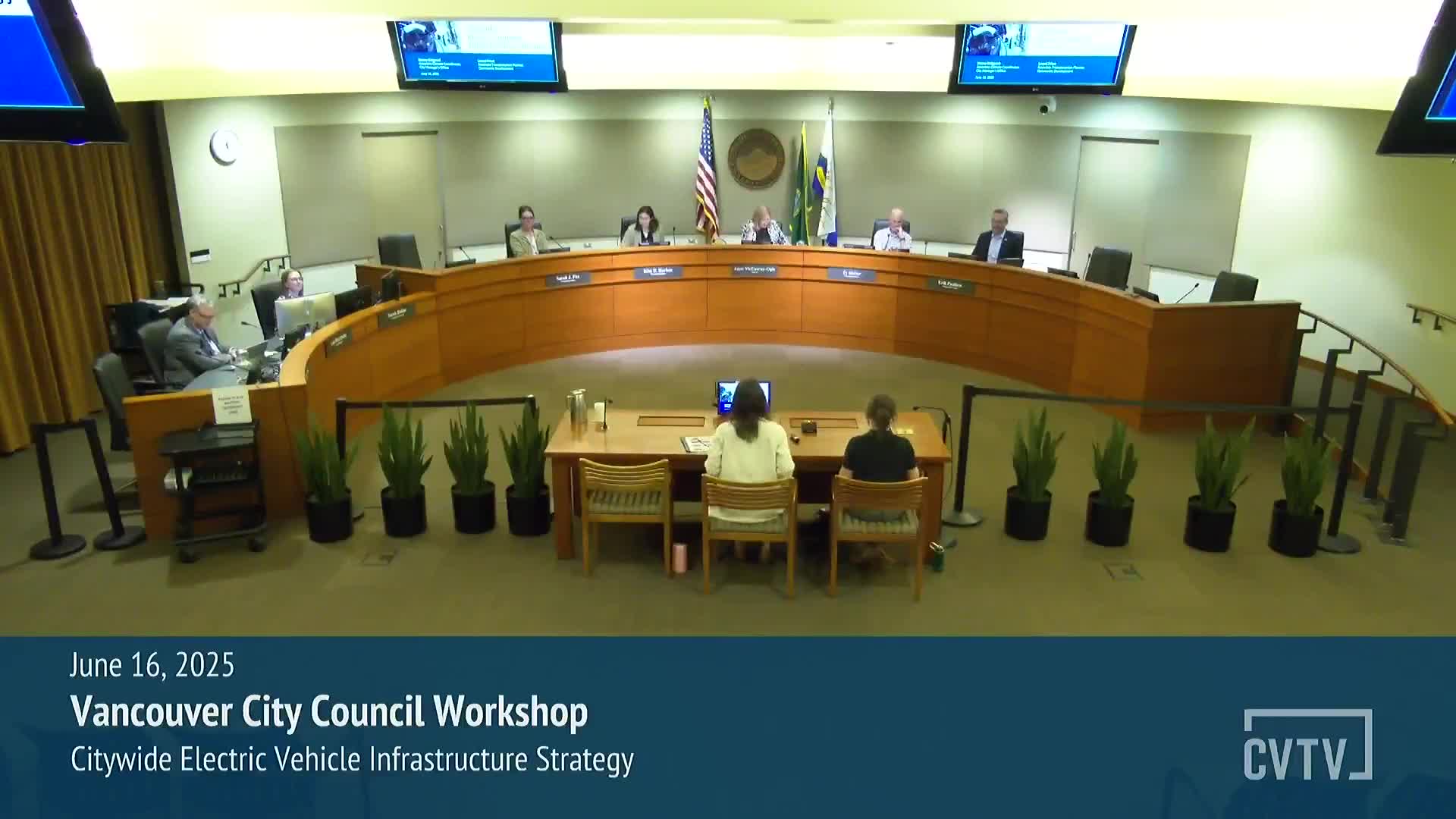
Vancouver begins EV charging strategy; staff say public and private investment both needed for equitable rollout
Summary
City climate and transportation staff on Monday outlined a draft EV charging strategy, saying public and private investment will both be necessary to meet projected charging needs and ensure an equitable transition to electric mobility.
City climate and transportation staff on Monday outlined a draft electric vehicle (EV) charging strategy, saying public and private investment will both be necessary to meet projected charging needs and ensure an equitable transition to electric mobility.
Stacy Dahlgaard of the city’s climate program said the transportation sector is the single largest contributor of emissions in Vancouver and that expanding public and private charging infrastructure is a priority in the city’s climate action framework. She said equity is central because many renters and low‑income households lack reliable home charging access and will depend on publicly available chargers or workplace charging.
Laurel Priest from Transportation Planning summarized the city’s current inventory and projected need: staff reported 113 publicly available level‑2 charging ports and 72 DC fast charging ports today, concentrated in commercial zones downtown, at the waterfront, Vancouver Mall and Mill Plain east of I‑205. Staff said the market is unlikely to deliver adequate chargers in multifamily and rental areas without some catalyzing public role.
Staff presented estimated targets and a planning horizon: they said Vancouver may need roughly one to two new publicly available DC fast charger ports per year and on the order of 100–150 new publicly available level‑2 ports annually to meet projected community demand through 2030. Those numbers, staff said, represent communitywide need and assume both public and private investment.
The presentation reviewed different municipal approaches elsewhere — from city ownership and operation, to revenue‑sharing partnerships with private charging companies, to enabling private development through incentives and technical assistance — and said the final recommendation for Vancouver will likely be a mix of roles. Staff noted examples they are monitoring: Seattle, Santa Monica, Bellevue, Portland and smaller peer cities.
Councilors asked practical questions about program design. Several councilors urged easy, low‑cost options for at‑home charging (including availability of standard 110‑volt outlets in some locations), technical and permitting assistance for multifamily and used car dealers, and careful accounting of what counts as “publicly available” chargers (some councilors said dealer chargers and chargers behind gated private lots should not be counted as public). Councilor comments stressed reliability and real‑time information for users and suggested features such as payment systems, Wi‑Fi or nearby amenities to make charging downtime useful for drivers.
Staff described the community engagement undertaken so far, including a cohort of community organizations working as outreach liaisons, 11 public outreach events and an online survey open through June 30 (beheardvancouver.org/evstrategy). Staff said they aim to return with a draft strategy in September and emphasized that they will test use cases (necessity charging for residents without home charging, convenience charging to reduce range anxiety, visitor and fleet charging) against equity and air‑quality priorities.
No formal action was taken at the work session; staff will continue community engagement and return with a draft strategy and an implementation plan that identifies city roles, potential partnerships and departmental responsibilities.