Get Full Government Meeting Transcripts, Videos, & Alerts Forever!
County committee forwards overhaul of incentive-zoning rules, lowering CRT threshold and adding new public‑benefit menu
Summary
The Planning, Housing and Parks Committee voted 3-0 to forward Zoning Text Amendment (ZTA) 25‑05 to the full council after agreeing to a new four‑tier public benefits menu, a requirement that projects buy BLTs or equivalent TDR payments, lowered CRT optional‑method threshold and grandfathering language for in‑process projects.
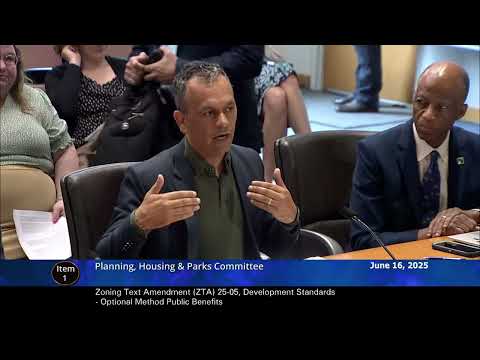
The Planning, Housing and Parks Committee voted 3‑0 on June 16 to forward Zoning Text Amendment (ZTA) 25‑05 — a multi‑year update to Montgomery County’s incentive‑zoning program — to the full County Council for final consideration.
The amendment replaces the county’s existing optional‑method public‑benefits system with a four‑tier menu that ties additional density to specified public benefits, lowers the threshold for optional‑method development in the CRT zone from 1.0 floor‑area ratio (FAR) to 0.5 FAR, and requires applicants using the optional method to purchase Building Lot Termination certificates (BLTs) or make an equivalent payment to the Agricultural Land Preservation Fund (ALPF) via Transferable Development Rights (TDRs).
Why it matters: The proposed ZTA is intended to make public‑benefit negotiations more predictable, to extract a wider set of community benefits from higher‑density projects near transit and employment centers, and to modernize a program that planning staff and their consultant said has not had a substantive update in more than a decade.
At the committee meeting, Ms. Nadeau, Council staff, summarized the draft and the packet materials and described the new structure: "The first major change in the ZTA is defining incentive density," she said, explaining the term as the difference between a project's standard‑method density and its mapped FAR. She noted the new menu requires at least one countywide benefit (housing or environment) and at least one locally focused benefit tied to applicable master plans, unless a project provides a tier‑4 benefit or requests only 0.25 FAR or less of incentive density.
Atul Sharma, project manager for the Planning Department, reviewed the background of the effort and the consultant work. "We've been working on this since 2023," Sharma said, describing the analysis of 15 years of prior projects and a set of six development prototypes used to test feasibility and cost of proposed public benefits.
Jay Brown, managing director of Hyde Brown, the county consultant, described the calibration work that informed the four tiers and the cost estimates. "We ultimately…
Already have an account? Log in
Subscribe to keep reading
Unlock the rest of this article — and every article on Citizen Portal.
- Unlimited articles
- AI-powered breakdowns of topics, speakers, decisions, and budgets
- Instant alerts when your location has a new meeting
- Follow topics and more locations
- 1,000 AI Insights / month, plus AI Chat