Get Full Government Meeting Transcripts, Videos, & Alerts Forever!
Get email alerts on the Incentive Zoning Zta 2505 topic
No spam. Unsubscribe anytime.
County committee forwards overhaul of incentive-zoning rules, lowering CRT threshold and adding new public‑benefit menu
Summary
The Planning, Housing and Parks Committee voted 3-0 to forward Zoning Text Amendment (ZTA) 25‑05 to the full council after agreeing to a new four‑tier public benefits menu, a requirement that projects buy BLTs or equivalent TDR payments, lowered CRT optional‑method threshold and grandfathering language for in‑process projects.
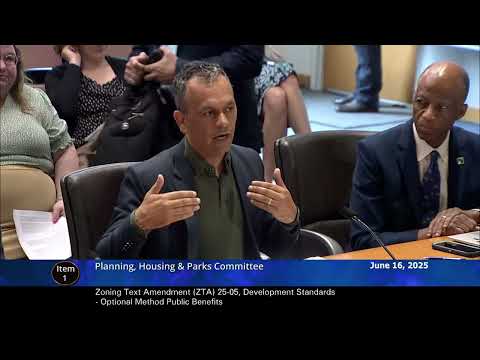
The Planning, Housing and Parks Committee voted 3‑0 on June 16 to forward Zoning Text Amendment (ZTA) 25‑05 — a multi‑year update to Montgomery County’s incentive‑zoning program — to the full County Council for final consideration.
The amendment replaces the county’s existing optional‑method public‑benefits system with a four‑tier menu that ties additional density to specified public benefits, lowers the threshold for optional‑method development in the CRT zone from 1.0 floor‑area ratio (FAR) to 0.5 FAR, and requires applicants using the optional method to purchase Building Lot Termination certificates (BLTs) or make an equivalent payment to the Agricultural Land Preservation Fund (ALPF) via Transferable Development Rights (TDRs).
Why it matters: The proposed ZTA is intended to make public‑benefit negotiations more predictable, to extract a wider set of community benefits from higher‑density projects near transit and employment centers, and to modernize a program that planning staff and their consultant said has not had a substantive update in more than a decade.
At the committee meeting, Ms. Nadeau, Council staff, summarized the draft and the packet materials and described the new structure: "The first major change in the ZTA is defining incentive density," she said, explaining the term as the difference between a project's standard‑method density and its mapped FAR. She noted the new menu requires at least one countywide benefit (housing or environment) and at least one locally focused benefit tied to applicable master plans, unless a project provides a tier‑4 benefit or requests only 0.25 FAR or less of incentive density.
Atul Sharma, project manager for the Planning Department, reviewed the background of the effort and the consultant work. "We've been working on this since 2023," Sharma said, describing the analysis of 15 years of prior projects and a set of six development prototypes used to test feasibility and cost of proposed public benefits.
Jay Brown, managing director of Hyde Brown, the county consultant, described the calibration work that informed the four tiers and the cost estimates. "We ultimately ended up with the right calibration," Brown said, adding that the firm tried to align the expected cost of benefits with what projects can feasibly deliver.
Key policy changes and clarifications
- Four‑tier benefit menu: The ZTA establishes four tiers of public benefits. Staff explained the example conversion to FAR values used in the packet: Tier 1 commonly supplies 0.25 FAR, Tier 2 1.0 FAR, Tier 3 1.5 FAR, and Tier 4 can satisfy the full requested incentive density for a project. (Exact FAR credit depends on the benefit and is set in the ZTA and implementation guidelines.)
- MPDU thresholds and deeper affordability: The ZTA includes specific MPDU (moderately priced dwelling unit) tiers. Planning staff explained the MPDU example: if a project's baseline MPDU requirement is 12.5%, providing 15% MPDUs would qualify for certain incentive density (staff cited a 1.25 FAR example), 17.5% for a higher tier, 20% for a still higher tier, and more than a 10 percentage‑point increase over baseline (for example, 22.5% or 25% depending on baseline) could qualify as a Tier‑4 benefit.
- Office‑conversion pilot interaction: The council recently passed an office‑conversion MPDU pilot that makes projects with at least 17.5% MPDUs eligible for a 20‑year property tax abatement. Staff noted the current ZTA language would allow a project using that pilot to also satisfy Tier 1 or Tier 2 MPDU thresholds for incentive density unless the council amends the text; the committee asked planning staff to model financial scenarios and return to full council with illustrative analyses.
- Agricultural preservation payments: For optional‑method projects, the ZTA would require purchase of BLTs or a TDR payment equivalent to be managed by the Agricultural Land Preservation Fund; the amount would be set and updated by the Office of Agriculture through regulation.
- Zones affected: The policy applies to projects in CR, CRT, LSC and EOF zones historically, but the ZTA removes optional‑method development for most parcels in the LSC and EOF zones and instead requires site‑plan review above 0.5 FAR in those zones. Planning staff said about 80% of EOF parcels lack sufficient FAR to trigger optional method and that most LSC land is now under the Great Seneca Life Sciences (GSLS) overlay.
- CRT grandfathering: Because the ZTA lowers the optional‑method threshold in the CRT zone from 1.0 to 0.5 FAR, the committee adopted amended grandfathering language for CRT‑area projects in process on or before the ZTA effective date. The adopted amendment allows projects with an approved or filed sketch plan, preliminary plan, site plan, conditional use, local map amendment, record plat or building permit to proceed under the standard‑method FAR that existed at the time of the project's original approval (the committee removed “concept plan” and replaced it with “sketch plan” in the final language).
- Alternative compliance and Tier‑4 constraints: The ZTA allows an applicant to seek an alternative compliance path from the Planning Board if unique site constraints make a standard benefit infeasible; staff emphasized Tier‑4 benefits should align with priorities established in the applicable master plan and that implementation guidelines will define criteria for major off‑site transportation or other Tier‑4 improvements.
- Payment in lieu and implementation guidance: The ZTA permits payments‑in‑lieu for certain categories (off‑site improvements, public facilities, street grid and multimodal extensions, art and placemaking, and public realm) when a master plan recommends a CIP project that can accept the payment. The implementation guidelines — a separate Planning Board document that will include definitions, examples and application requirements — are not subject to council approval but will be available to the public and to applicants.
Committee action and next steps
Chair Bryant closed the session after committee members and staff agreed to a single bring‑back item: planning and council staff will return to the full council with financial scenarios and case studies showing how the office‑conversion tax abatement and the ZTA's incentive calculations would interact in practice.
The committee chair announced the package will be forwarded to full council with a positive committee report. "We will positively review this 3 to nothing out of committee and forward it to the full council for consideration," Chair Bryant said.
The full council will consider ZTA 25‑05 and any technical or substantive amendments; if the council adopts the ZTA, implementing regulations and the implementation guidelines will define payment levels (including BLT/TDR equivalencies), Tier‑4 definitions and other application requirements referenced in the ZTA.
Meeting context and background
Planning staff described the ZTA as the product of stakeholder engagement starting in 2023, Planning Board review, and a public hearing held June 10. Staff and the consultant said the menu and tiers were calibrated using cost estimates, project prototypes and analysis of 15 years of prior optional‑method approvals. Planning staff and the consultant highlighted efforts to coordinate with county agencies including DOT, DPS, DHCA, the Office of Agriculture and the county executive’s office during drafting.
Limitations and outstanding issues
Committee members asked staff to produce further analysis on how the office‑conversion tax abatement and MPDU tiers would function together in real project scenarios, and to model whether the abatement could double‑count as an incentive for projects to reach mapped FAR without providing additional affordability. Planning staff agreed to return with scenarios and recommended thresholds.
The committee also accepted several technical edits proposed at the meeting, including referring to the International Green Construction Code by name and adopting a LEED reference that will track the most current LEED BD+C version at the time of approval.
For now, the ZTA remains a work product under review: the committee voted to forward the measure to full council and requested follow‑up financial scenarios and clarifications before the final vote.
Ending note: The project team told the committee this update aims to balance predictability for applicants with measurable public benefits for communities near transit and employment centers; full council consideration will determine final thresholds, grandfathering dates and regulatory details.