Get Full Government Meeting Transcripts, Videos, & Alerts Forever!
Get email alerts on the Pension Lehi1 topic
No spam. Unsubscribe anytime.
Select Committee discusses Lehi 1 merger/termination options, unfunded-liability pause and schedules legal, actuarial briefings
Summary
The Select Committee on Pension Policy spent its meeting reviewing options for the overfunded Lehi 1 plan — including termination, restatement or merger — asked staff for fiscal and actuarial materials, flagged IRS and ERISA issues for legal review, and penciled a September discussion on cost-of-living adjustments (COLA).
The Select Committee on Pension Policy on June 1 discussed options for the Lehi 1 retirement plan — including merger, termination and a “termination and restatement” approach — and asked staff to gather actuarial and legal analysis before making recommendations.
The committee focused on three near-term items: obtaining actuarial work products and fiscal notes for pending bills, clarifying the legal and federal tax implications of any plan change, and scheduling educational briefings, including a high-level July overview and a deeper review with outside counsel later in the interim.
Luke Masling, senior actuary with the Office of the State Actuary, told the committee the actuarial team is “kind of at capacity right now” because of annual valuations, a biannual economic experience study and a once-every-six-years demographic review. “All that is to say the actuarial team is kind of at capacity right now,” Masling said, and staff indicated they would provide relevant fiscal notes and actuarial materials to the committee.
Committee members repeatedly raised two linked concerns: protecting benefits for current Lehi 1 members if the plan is merged or restated, and understanding how federal tax rules and IRS treatment could constrain options. Senator Conway noted the committee is considering a four-year pause in unfunded-liability payments and asked how that pause affects long-term funding: “I only had one discussion. That was that we’re terminating the unfunded liability payment for 4 years,” he said during the meeting. Committee staff and the actuary explained the pause reflects prior prescribed rates, projection assumptions and expected investment returns, but cautioned that projected investment performance could change funding needs in the future.
Catherine Leathers, identified in the meeting as director, urged clearer language in committee materials to avoid misunderstanding. “I think it might be useful going forward to refer to the termination proposal as a termination restatement proposal,” Leathers said, noting some public testimony had confused “termination” with eliminating the Lehi 1 plan outright.
Committee members also asked legal counsel and staff about federal tax consequences, plan qualification and statutory constraints. Aaron (staff member) told the committee he planned to request written analysis from outside counsel Ice Miller and to coordinate follow-up presentation logistics. “I don’t anticipate having the answers from them by July, but some of these fundamental questions ... I can talk to the committee and educate the committee on why some of this stuff exists and why it’s relevant,” Aaron said.
On cost-of-living adjustments for Plan 1 members, multiple members urged that COLA remain on the committee’s agenda. The committee agreed to schedule an informational item on COLA options in September that would include background and order-of-magnitude fiscal context rather than firm budget estimates. Members also agreed to pencil an excess-compensation (sometimes called “pension spiking”) briefing into December as a possible supplemental item, contingent on coordination with the Plan 2 board’s planned study.
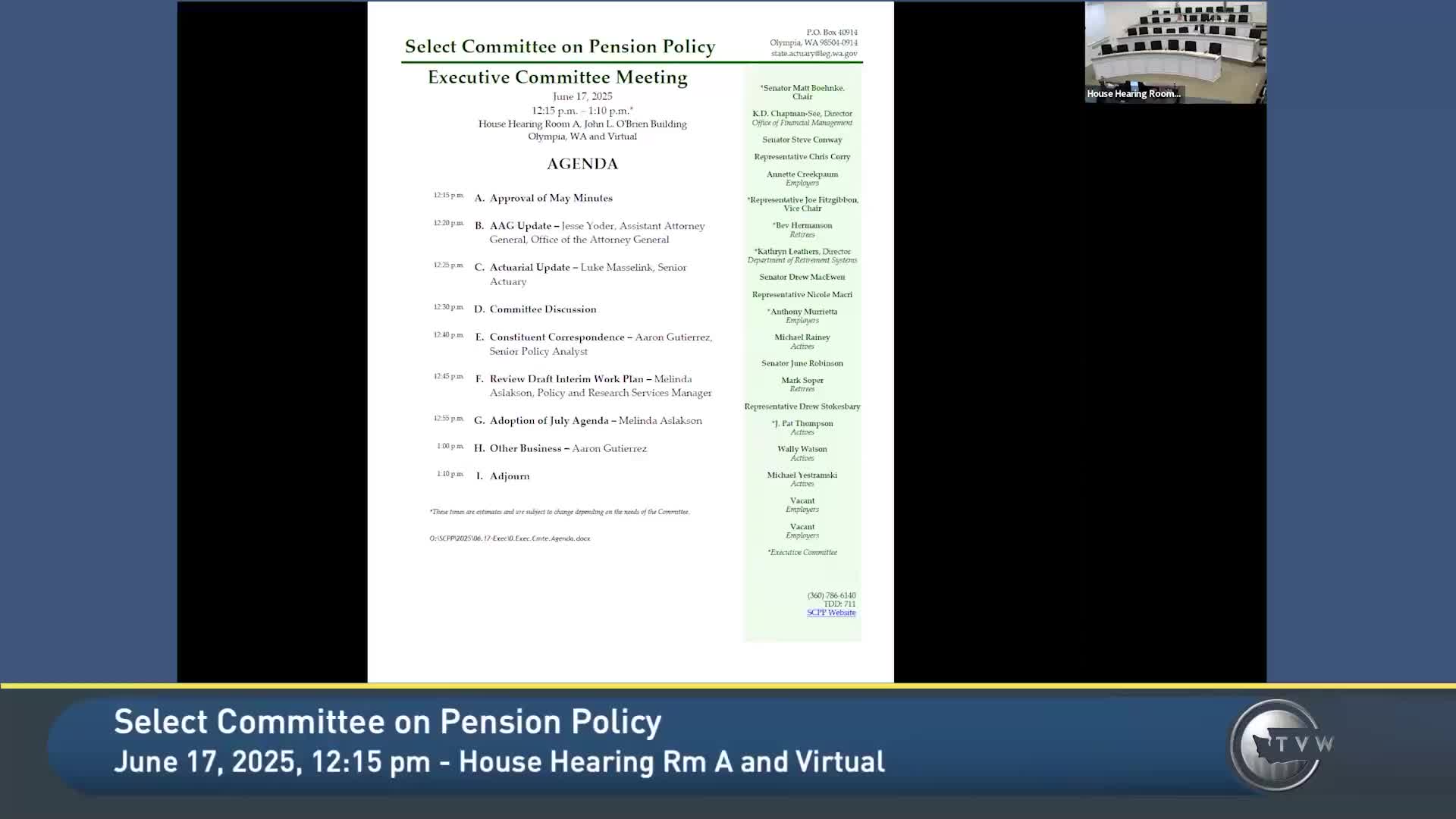
Procedural actions taken during the meeting included approval of the May minutes (approved, recorded as six ayes during the roll call) and adoption of the July agenda (approved by voice vote). The committee closed by asking staff to gather the requested actuarial materials and to pursue legal guidance from Ice Miller for later review.
Why this matters: Lehi 1 was described in committee discussions as substantially overfunded relative to typical funding levels, and members said clarifying the legal, federal tax and actuarial implications is necessary before recommending changes. Any committee recommendation on merger, termination or restatement could affect benefit design, employer/employee contribution patterns and state budget planning.