Get Full Government Meeting Transcripts, Videos, & Alerts Forever!
Get email alerts on the Leoff1 Study topic
No spam. Unsubscribe anytime.
Select Committee launches LEOFF 1 merger/termination study; retirees and stakeholder groups urge opposing paths
Summary
Committee staff launched a budget-proviso study of a proposed LEOFF 1 merger and of a termination option and described the timeline and required legal, tax, actuarial and administrative analyses; public testimony overwhelmingly opposed transferring LEOFF 1 funds to the state treasury.
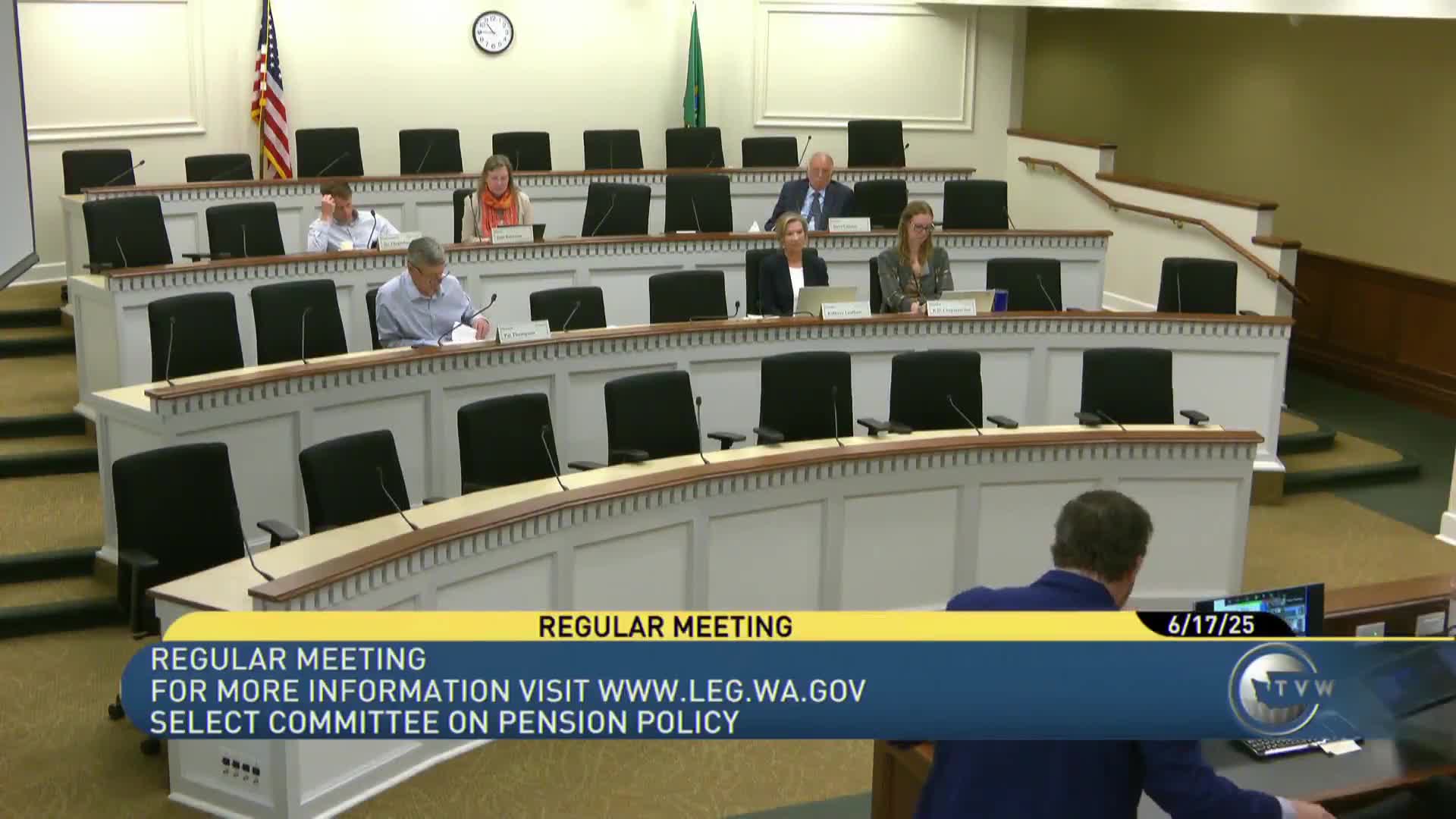
Committee staff introduced a mandated study of two legislative approaches related to LEOFF 1 — a merger and a termination — during the Select Committee on Pension Policy’s June 17, 2025 meeting and described the study timeline, participants and requested analyses.
Eric Gutierrez, committee staff, said the 2025–27 operating budget includes a proviso requiring the committee to study the tax, legal, actuarial, pension-policy and administrative implications of Substitute Senate Bill 5085 (a merger proposal) and Substitute House Bill 2034 (a termination proposal). Gutierrez outlined a schedule that begins with educational briefings, requests analyses from the Attorney General and the Office of the State Actuary, and aims to deliver a final report by January 9, 2026 to the fiscal committees of the Legislature. The staff plans to request a public (non-privileged) federal-tax analysis from Ice Miller LLP and invited the firm to appear before the committee; the staff will also coordinate with the Department of Retirement Systems, the State Investment Board and the State Treasurer for administrative and investment implications.
Gutierrez said prior studies (OSA 2011 and a 2016 select-committee study) covered similar ground. He described two study tracks: (1) a merger of LEOFF 1 with PERS 1 and TERS 1 and (2) termination of LEOFF 1. He noted LEOFF 1 had been well funded (149% as of the June 30, 2023 measurement referenced) and that the study proviso does not prescribe specific recommendations; staff will draft options and decision points so the committee can consider whether to make legislative recommendations.
Public testimony in the meeting largely addressed the study’s policy choices. Fred Yancey, representing the Washington State School Retirees Association and two school-administration associations, said ESSB 5357 delivers near-term savings but raises the risk of higher future contribution rates and could make restoring a recurring COLA for Plan 1 members more difficult. "The bad news... is that there's a risk, and I think it's a high degree of risk, of an increase in rates," Yancey said.
Retiree organizations and individual LEOFF 1 members urged the committee not to use LEOFF 1 funds for state budget relief. Michael Dushman, president of the Retired Firefighters of Washington, told the committee he opposes bills like SSB 5085 and SHB 2034 and warned of IRS and legal obstacles; "Washington State should not be the first state to do so," he said. Several LEOFF 1 retirees said the surplus funds were earned for plan members and opposed any transfer of assets to the state treasury. David Marin, a LEOFF 1 retiree, said "there is unanimous LEOFF 1 member opposition to the taking of any funds from the LEOFF 1 pension." Brad Reynolds and other speakers raised specific concerns about whether municipal medical-benefit obligations tied to LEOFF 1 would survive a merger or termination.
Stakeholders also raised other topics on the public-record: climate and investment-policy commenters asked the committee to press the State Investment Board to align investments with state climate goals; retirees urged restoration of purchasing power for Plan 1 benefits.
Gutierrez said staff will request public tax and legal analyses (with the option of supplemental confidential briefings if the committee requests privileged work product). The staff plans an educational briefing on plan qualification and tax law the following month and expects to circulate an initial draft report in September with a final report by early January 2026. The committee is asked to decide whether it will accept confidential analyses in addition to public memos; staff’s default is to request public analyses for inclusion in the printed report.