Get Full Government Meeting Transcripts, Videos, & Alerts Forever!
Get email alerts on the Economic Development topic
No spam. Unsubscribe anytime.
Greater Vancouver Chamber outlines programs, launches executive dialogue for Battle Ground businesses
Summary
Representatives from the Greater Vancouver Chamber described membership services, workforce and small‑business supports, and a new monthly "executive dialogue" to convene local CEOs and business leaders in Battle Ground.
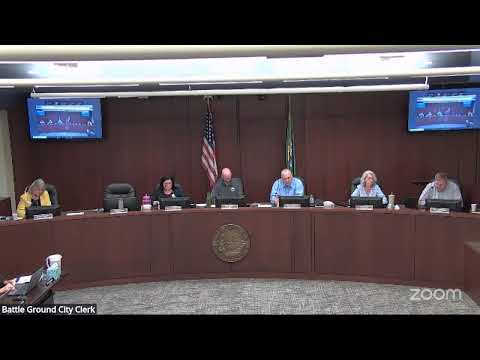
John McDonough, president and CEO of the Greater Vancouver Chamber, told the Battle Ground City Council on June 16 that the chamber has expanded services in the city since it began operating Battle Ground Chamber functions in 2018 and wants to give local businesses a stronger voice.
The chamber presentation outlined programs ranging from COVID relief and small-business technical assistance to a local currency gift-certificate program and a workers’ compensation refund program for manufacturers, and introduced an "executive dialogue" that will convene CEOs and senior executives from businesses located in and around Battle Ground.
The chamber said it distributed $5,300,000 in COVID-19 grants regionally and that $312,370 of that total went directly to Battle Ground brick-and-mortar businesses. Janet Kefetzky, a chamber staff member, described the chamber’s Spend It Local program — regional gift certificates redeemable at more than 70 participating merchants — and said roughly $200,000 has already been spent through the program with about $80,000 still outstanding in certificates. Kefetzky said merchants report average additional spending of 39 percent above the certificate value when a customer redeems a certificate.
The presentation also highlighted the chamber’s program that helps manufacturers recoup part of their workers’ compensation premiums. "To date this program has returned about $12,000,000 in refunds to Southwest Washington manufacturers," Kefetzky said, adding that participants must meet safety standards and allow plan inspections. The chamber said about 60 manufacturers currently participate in the retrospective-rating plan.
McDonough and Kefetzky described other services — workforce development internships coordinated with local colleges and school districts, business start‑up training for microenterprises (they said about 25 Battle Ground entrepreneurs had completed the training), leadership programs, and data analytics the chamber provides for policy discussions.
Council members asked where the chamber gets its business and employee data. Kefetzky said the chamber draws on Census and ERSA economic databases and regional data the chamber licenses and collects through its own membership intake. "We can send you the link to the economic database that we get it from," she told the council.
The chamber said it convened its first local executive dialogue in Battle Ground about a month earlier; attendees asked the chamber to meet monthly and identified housing, workforce and transportation as the top priorities they wanted the group to address. The chamber invited council participation as an ad hoc sounding board rather than as formal members of the executives’ group.
Council members and the chamber agreed to continue the partnership; the chamber offered to provide data and briefings to help local policymakers evaluate workforce and housing options based on local commuting, vacancy and demographic statistics.
The presentation closed with offers to share the chamber’s slide deck and data links with council and staff.