Get Full Government Meeting Transcripts, Videos, & Alerts Forever!
Get email alerts on the Wastewater topic
No spam. Unsubscribe anytime.
Fond du Lac council approves CMAR, hears multi-million biosolids dryer and RNG plan for treatment plant
Summary
Council unanimously approved the wastewater facility's Compliance Maintenance Annual Report and heard a detailed presentation on a biosolids dryer and renewable natural gas (RNG) pipeline-injection project that staff said will reduce hauling, produce a Class A dried biosolid product and could generate revenue from RNG sales and credits.
The Fond du Lac City Council on June 11 unanimously approved the Compliance Maintenance Annual Report (CMAR) for the wastewater treatment and resource recovery facility and received a presentation on a combined biosolids drying and renewable natural gas (RNG) project intended to reduce hauling costs, increase storage and produce marketable products.
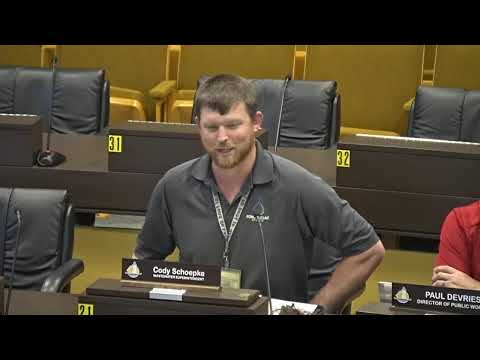
Superintendent Cody Shepke presented the CMAR and project update. He told the council the 2024 CMAR score was 3.92 out of 4 and said two high-flow bypass events tied to significant rainfall in May through July 2024 prevented a perfect score. "I am happy to report that in 2024 we received a 3.92 out of 4," Shepke said. The council approved resolution 9183 to accept the CMAR.
The nut graf: city staff outlined two connected capital initiatives at the plant. A biosolids dryer would remove more than 70% of water from dewatered sludge to produce a Class A (exceptional quality) dried product the superintendent compared to Milorganite. An RNG pipeline-injection system would clean and upgrade biogas from the plant's digesters to near-pipeline quality methane, allowing the city to use or sell nearly all the gas it now sometimes flares.
Shepke summarized operational context and drivers: limited outlets for land application of biosolids, escalating landfill hauling costs, storage constraints at the plant, upcoming tighter permit phosphorus limits, and emerging contaminant testing (PFAS, microplastics, pharmaceuticals). He said staff expect a new phosphorus permit likely this fall and noted the plant's partnership with Fond du Lac County Airport on a water-quality trading project designed to generate credits to offset low phosphorus limits.
On staffing and operations, Shepke said the plant added a maintenance mechanic (Brian Schmitz) and restructured lab staffing to one full-time and two part-time analysts; an industrial pretreatment coordinator position was filled internally by Kyle Casper; one operator vacancy remained. He described work to optimize biological phosphorus removal and reduce inflow and infiltration in the collection system.
Project specifics presented: the dryer (a screw dryer marketed by BCR) will use heated oil to evaporate water and produce a fine, dried biosolid suitable for land application or commercial use; pilot drying samples were tested. The project includes just over one month of biosolids storage at the plant to limit daily hauling. Shepke said construction site work was planned to begin "next week" and the team hopes to be online in late summer or early fall 2026, subject to long equipment lead times.
On RNG, Shepke said the plant currently uses about 60% of its biogas and flares the remainder. The RNG project would upgrade raw biogas by removing corrosive contaminants and carbon dioxide, producing near-pipeline-quality methane. That fuel could be marketed directly, sold to transportation markets, or monetized through renewable fuel credits (RINs) or voluntary corporate purchases; Shepke described credits and the voluntary market as possible revenue sources. He also noted the potential, at a later date, to recover and market refined carbon dioxide.
Council members asked about regulatory risk from PFAS and other contaminants, what industrial wastes are accepted at the plant, credits and markets for RNG, and energy use for the dryer. Shepke answered that recent PFAS sampling has shown low levels, that the plant screens and samples industrial waste before accepting it (noting most hauled wastes are food-grade/dairy in the region), that RINs and other credit markets are options under evaluation, and that the dryer will use a natural-gas-fired boiler to heat oil with some heat reuse in the system.
Ending: Council did not take an immediate action on the dryer/RNG presentation; the CMAR acceptance was the formal action. Shepke invited council members to tour the plant when the new work is underway.