Get Full Government Meeting Transcripts, Videos, & Alerts Forever!
Get email alerts on the Regional Energy Cooperation topic
No spam. Unsubscribe anytime.
Northeast states and Atlantic provinces push cross‑border energy partnerships, from hydro and nuclear to offshore wind
Summary
Governors and premiers at the Boston convening highlighted transmission, hydroelectric imports, nuclear and offshore wind as priorities for regional energy reliability and decarbonization; officials described specific projects and potential megawatt capacities while urging federal support for cross‑border infrastructure.
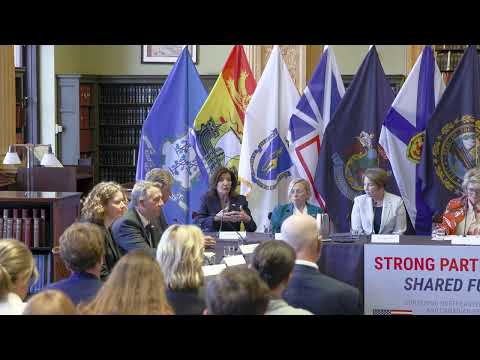
Regional leaders at a Boston convening emphasized energy cooperation as a concrete area for U.S.–Canadian collaboration to improve reliability, affordability and decarbonization across the Northeast and Atlantic provinces.
Why it matters: States and provinces in the region share electricity sources, fuel deliveries and transmission corridors. Officials said coordinated procurement, shared transmission investment and development of new generation could lower costs, improve resiliency and support electrification for industry and households.
What was discussed: Several speakers pointed to existing and proposed projects. Premier Hogan said much of the hydropower flowing through Quebec originates on Labrador's Churchill River and described an ongoing effort to upgrade facilities and expand production from "about 5,000 to 9,500 megawatts." Premier Houston and others discussed Nova Scotia's offshore wind potential and said an early estimate for initial development could be on the order of tens of gigawatts; Houston described the province's first planned offshore wind projects and regional transmission collaboration. Premier Ford and Governor Scott both advocated for nuclear and small modular reactor (SMR) technologies as sources of reliable base load power to support electrification and data‑center growth; Ford called Ontario a leader in SMR development.
Speakers noted shared transmission and procurement options. Governor Hochul and others described the strategic value of Quebec hydropower to meet near‑term load growth, and Governor Scott said Vermont receives roughly 50% of its energy from Canada, with about 25% from Hydro‑Quebec. Participants discussed an "Eastern Energy Partnership" concept and referenced work by regional leaders and private partners to identify large projects of mutual interest.
Quotes and context: "We have an opportunity to continue to develop green energy options," Premier Hogan said about Newfoundland and Labrador's role in regional supply. "We need base load power," Governor Scott said, arguing that nuclear will be a necessary component of further electrification to support artificial intelligence and increased power demand.
Ending: No binding energy procurement or construction agreements were signed at the meeting. Leaders committed to further study, bilateral talks and regional planning to identify transmission upgrades and generation projects that could be pursued jointly or coordinated across jurisdictions.