Get Full Government Meeting Transcripts, Videos, & Alerts Forever!
Get email alerts on the Land Use topic
No spam. Unsubscribe anytime.
Santa Fe County commissioners grant nearby resident standing, deny pre‑hearing discovery in Rancho Viejo Solar appeal
Summary
Santa Fe County commissioners on Oct. 11 granted standing to a nearby resident who asked to participate as an interested party in the appeal of the Rancho Viejo Solar conditional‑use permit and declined a request for formal pre‑hearing discovery, while approving an order that sets the pre‑hearing procedures and scheduling for the full merits hearing.
Santa Fe County commissioners on Oct. 11 granted standing to a nearby resident who asked to participate as an interested party in the appeal of the Rancho Viejo Solar conditional‑use permit and declined a request for formal pre‑hearing discovery, while approving an order that sets the pre‑hearing procedures and scheduling for the full merits hearing.
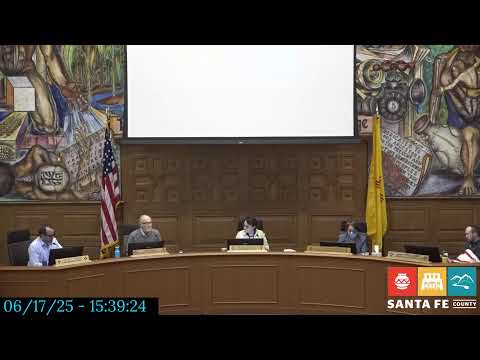
The ruling came at a pre‑hearing conference before the Santa Fe County Board of County Commissioners, chaired by Commissioner Camilla Bustamante. "My name is Camilla Braum, and I'm requesting status as an interested party for the upcoming BCC hearing," Braum told the commission, saying she is an adjacent property owner and that "I rely on groundwater from a well situated approximately a half a mile southwest of the proposed facility." Braum said her concern centers on groundwater flow and potential contamination tied to the project's planned use of lithium‑ion batteries.
Why it matters: the board's decision determines who may present evidence at the full hearing and what information opponents may compel from the applicant in advance. Commissioners said the ruling balances due‑process notice and the practical limits of a lengthy public hearing while preserving the ability of opposing parties to question witnesses during the merits hearing.
The commission considered two competing procedural requests. Ashley Schonauer, an opponent who previously participated in the case, filed a renewed motion to compel discovery seeking, among other things, amounts of damages claimed against AES for prior accidents, reports describing causes of any accidents, and information about the identity and assets of Rancho Viejo Solar LLC, the entity expected to operate the facility. "The purpose of discovery is that in any case in which a party presents testimony... they're not gonna be presenting information that's not favorable," Schonauer said, arguing some records are solely controlled by the applicant and therefore only obtainable through discovery.
Local counsel for the applicant, Luke Pierpont, said the applicant had already submitted thousands of pages of application materials and supporting reports and argued that New Mexico law and the county code do not require the kind of discovery used in district‑court litigation. "We do feel that [the request] would be duplicative," Pierpont said, adding the applicant has responded to county staff requests and will answer questions from the board during the hearing process.
County Attorney Boyd and growth‑management staff explained the procedural distinctions. County counsel noted the Sustainable Growth Management Plan (SGMP) directs that rules for discovery be provided consistent with due process, but the county's Sustainable Land Development Code (SLDC) does not itself contain a formal discovery procedure. Growth‑management staff said an environmental impact report for the original application is on the county website.
After a closed executive session, the board voted to grant Braum status as an interested party at the hearing and to deny Schonauer's request for pre‑hearing discovery; the board explicitly allowed Schonauer to conduct cross‑examination of witnesses at the merits hearing. The board additionally approved an order governing pre‑hearing procedures and the scheduling of the hearing; parties recognized as having standing were asked to provide email addresses for a service list so the order and subsequent filings can be distributed.
Commissioners gave procedural guidance rather than setting a hearing date in public session: staff distributed a printed order that will be emailed to parties and placed on the appeal docket; the chair asked parties to be prepared to raise or answer the discovery‑style questions during the merits proceedings so the hearing can proceed without unnecessary delay. The county's memo on scheduling and access issues was referenced during the conference.
What the record shows: the board's action is a procedural determination about participation and evidence exchange, not a decision on the conditional‑use permit itself. Commissioners and counsel repeatedly distinguished between (1) this pre‑hearing process, (2) evidence that will be considered at the merits hearing, and (3) the substantive standards the board will apply under the SLDC and SGMP for a conditional‑use permit.
Next steps: the commission approved the pre‑hearing order and asked recognized parties to provide email addresses to the county attorney for the service list; the full merits hearing will proceed under the schedule and rules set in that order. The board did not adopt a separate timeline or public‑hearing date on the record during the conference; the order will specify timing and procedures and will be circulated to parties.