Get Full Government Meeting Transcripts, Videos, & Alerts Forever!
Get email alerts on the Impact Fees topic
No spam. Unsubscribe anytime.
Palm Coast Council adopts large across-the-board impact fee increases, exempts accessory dwelling units from exemption
Summary
City Council approved updates to fire, parks and recreation, and transportation impact fees after a comprehensive study and an extraordinary-circumstances finding; council clarified that accessory dwelling units will be treated as additional dwelling units for fee purposes.
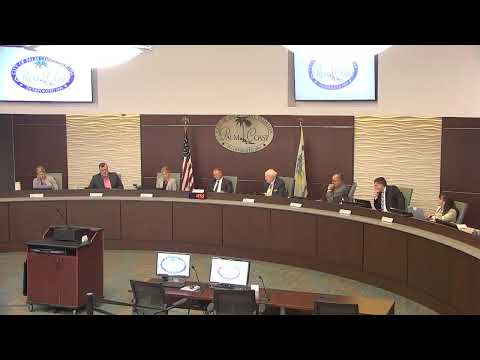
Palm Coast City Council voted unanimously June 17 to raise impact fees for fire, parks and recreation and transportation following a comprehensive study and an extraordinary-circumstances analysis.
The ordinances, explained during multiple agenda items by city consultants and staff, increase the city’s fee schedule for new development. City staff and outside consultants presented the technical basis, showing higher construction and road project costs since the city’s last fee update in 2018 and modeling alternatives that included a roughly $30 million funding offset. Jonathan Paul, principal of New Urban Concepts, said moving to a square-foot basis for residential transportation fees would “make a smaller home pay a smaller fee and a larger home pay a larger fee,” and presented revised per-thousand-square-foot and per-unit figures used in the council’s deliberations.
Council members debated several technical details, including whether pre-platted ITT lots should continue to receive a reduced transportation rate because of preexisting infrastructure. Several members, including Vice Mayor Pontieri and Council member Sullivan, questioned that carve-out; council ultimately directed staff to remove the vested ITT platted-lot rate from the ordinance and apply the same rates across similar residential categories. Council also discussed concerns about housing affordability; the consultants said shifting to square-foot fees reduces the burden on smaller homes, though larger homes would pay more.
The council made a specific code change during second reading of the fire and parks ordinances to address accessory dwelling units (ADUs). Vice Mayor Pontieri proposed — and the council adopted — a minor amendment to the exemption language in the impact-fee code so that ADUs would not be exempt. The approved language treats accessory dwelling units “as an additional dwelling unit for impact-fee purposes” so they will incur the same fees as separate dwelling units.
Council members repeatedly framed the fee increases as “course correcting” after years without an update; staff noted the city borrowed about $3 million from the general fund to pay for recent fire station projects because prior fee levels were insufficient. Staff and consultants also presented comparative data showing Palm Coast remains relatively affordable compared with several fast-growing Florida municipalities even after the increases.
The council approved the three ordinances as presented (fire and parks on second reading; transportation on first reading), with votes recorded as unanimous at each recorded roll call. Staff and consultants said the transportation schedule will be revisited as part of the next scheduled update in four years, and the statutes and ordinance language allow later code amendments if state law or council direction changes.