Get Full Government Meeting Transcripts, Videos, & Alerts Forever!
Get email alerts on the Blue Hill Avenue Redesign topic
No spam. Unsubscribe anytime.
Mattapan residents, businesses press council over Blue Hill Avenue redesign; oppose center-running bus lane
Summary
Councilor Julia Mejia, chair of the Boston City Council Committee on Post Audit, Government Accountability, Transparency, and Accessibility, convened a June 10 hearing in Mattapan on the Blue Hill Avenue Transportation Action Plan; hundreds of residents and small-business owners came to oppose, in particular, a proposed center-running bus lane and to press the city for clearer mitigation and outreach.
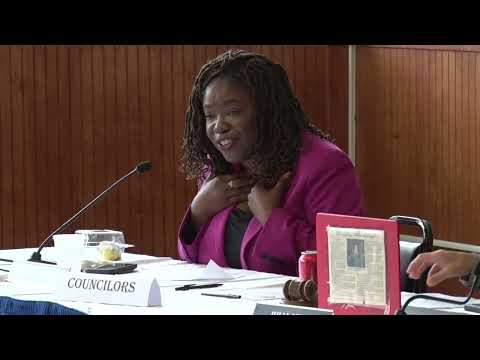
Councilor Julia Mejia, chair of the Boston City Council’s Committee on Post Audit, Government Accountability, Transparency, and Accessibility, opened a June 10 community hearing in Mattapan to review the Blue Hill Avenue Transportation Action Plan, saying “the process, as I always say, is just as important as the outcome.”
The hearing drew residents, business owners and neighborhood leaders who said the project as currently drafted — particularly a center-running bus lane — would remove curb parking, complicate deliveries and endanger seniors and people with limited mobility. They urged more funding, clearer mitigation for small businesses during construction and better, multilingual outreach before the city advances a final design.
Why it matters: Blue Hill Avenue carries a dense mix of transit riders, small Black- and Brown-owned businesses, churches and homes. City planners and the MBTA say the corridor serves roughly 37,000 daily bus riders and that congestion causes large daily delays for transit. The administration says the concept design would shorten many crosswalks, add new signalized crossings and create dedicated bus right-of-way to improve speed and reliability, while preliminary city estimates put available local capital at $18 million and a federal RAISE grant at $15 million. Project estimates presented in public testimony ranged from the city’s cited figure (about $44 million) up to community estimates of $100 million to fully address the corridor’s needs.
Most speakers asked the city to pause or significantly revise the current center-running design. Fatima Ali Salam, speaking for the Greater Mattapan Neighborhood Council, said the council’s board “do not support most of the proposed TAP components in their current form,” and called for greater investment, protections for local hiring and designated supports for small businesses during construction.
Small-business concerns: Denise Omad, owner of Cafe Juice Up, told the panel she had repeatedly heard from customers who drive from suburbs to her shop and would no longer come if curb parking is removed. “What will the impact control strategy be for a small business that lines the Blue Hill Avenue corridor?” she asked. Several merchant speakers asked the city to convert more short-term spaces to 15-minute curb slots and to create dedicated loading zones so deliveries and customers can access storefronts during construction.
Accessibility and safety: Speakers also raised safety concerns for elders and people with disabilities about boarding from a center island. The administration responded that center-running platforms are built to ADA standards and include raised boarding platforms, shelters and signalized crosswalks. Chief of Streets Yascha Franklin Hodge said the corridor is in the top 3 percent of Boston streets for crash rates and that improvements should reduce crash risk: “Blue Hill Ave can be safer, greener, more functional, and more beautiful.”
Transit arguments: Transit advocates and some elected officials said dedicated bus lanes are the accepted practice for busy corridors. Transit Matters staff described buses on Blue Hill Avenue among the system’s slowest and most “bunched,” and said center-running lanes on Columbus Avenue produced measurable time savings while minimally affecting single-occupancy vehicle travel times. State Rep. Russell Holmes, a longtime participant in corridor planning, said he has listened to both longtime opponents and pro-transit voices and emphasized the transit-dependent riders who “literally don’t realize you can go up to Mattapan Square, there will be 20 people sitting there right now waiting for that bus.”
Engagement and next steps: City staff described a multi-year engagement program that included pop-ups, workshops, targeted business outreach, youth events and a 2023 engagement report. The city said it reached roughly 23,000 people through outreach and recorded nearly 3,000 direct engagements and more than 2,000 comments. Panelists and several business owners said outreach did not reach many non-English speakers or some small merchants, and requested more sustained, door-to-door contact, multilingual materials and clearer funding scenarios. City staff said the concept is at roughly 15 percent design and that final scope will depend on additional federal funding; they also said the current plan preserves about 90 percent of curb parking in the concept but acknowledged strong neighborhood concern about any lost parking.
What was not decided: No formal vote, motion or final approval occurred at the hearing. Councilors and residents asked the administration to continue block-by-block outreach and to return with clearer mitigation proposals for businesses, concrete parking-management plans, and a transparent accounting of funding scenarios. City staff and the MBTA said federal grant decisions will shape what can be built and when.
Looking ahead: Council members urged continued engagement and asked the administration to report back with updated designs and a detailed mitigation package for small businesses and residents before the project advances to later design phases. Several speakers said they will press elected officials and the MBTA board as the grant process and design work continue.
The hearing provided a public record of both firm community opposition to a center-running bus lane and repeated requests for safer sidewalks, better crosswalks, more trees and clearer business protections — issues the city says remain under active discussion as the project’s funding and design evolve.