
OU students present plan for a year‑round low‑barrier shelter in Norman, urge council task force and funding strategy
Get AI-powered insights, summaries, and transcripts
Subscribe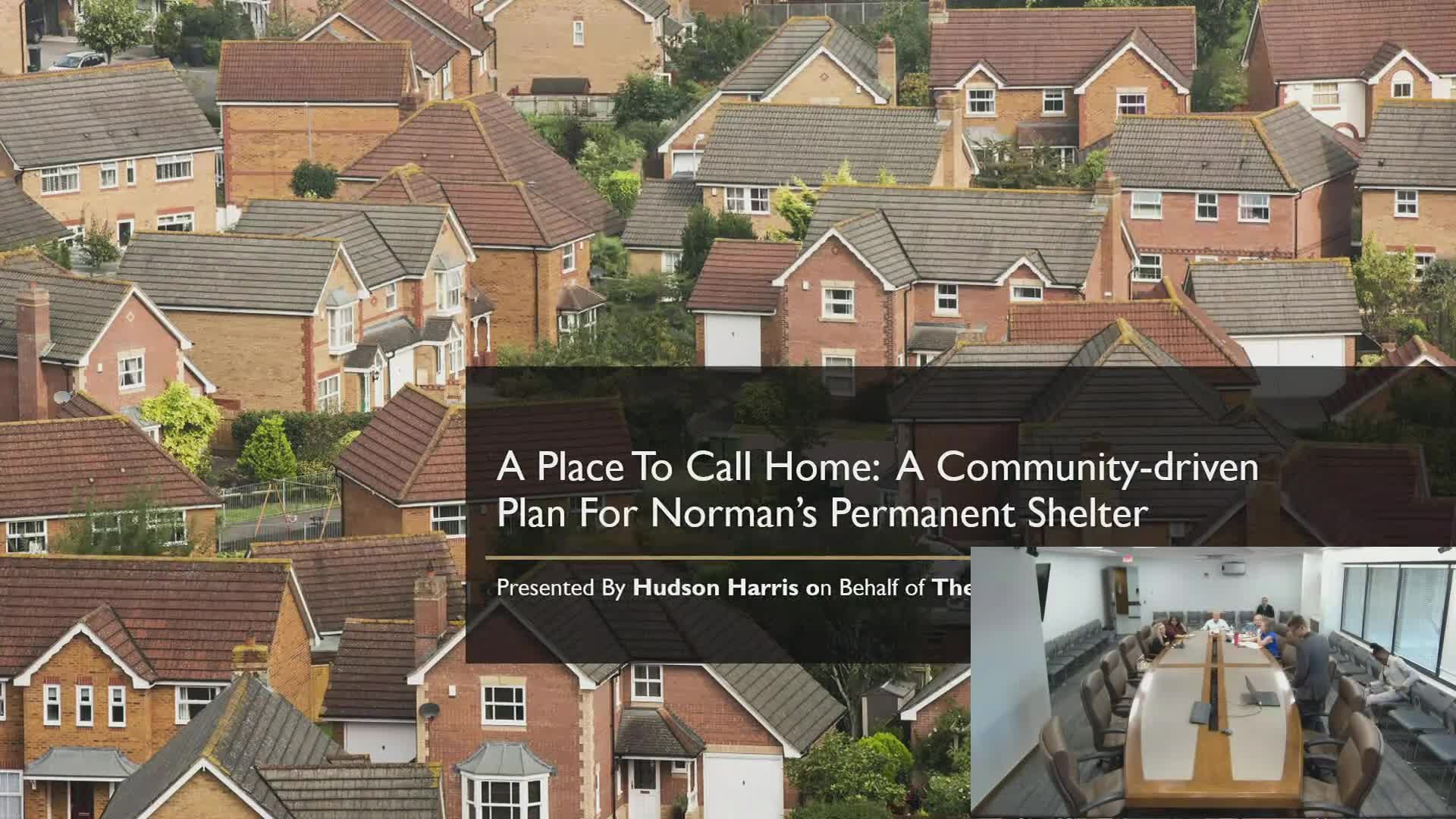
Summary
University of Oklahoma students on June 12 presented A Place to Call Home, a community‑driven plan that recommends a year‑round, low‑barrier shelter for Norman, proposed a set of candidate sites (including land near Griffin Memorial), and urged the City Council Oversight Committee to establish a shelter planning task force and begin funding work now.
University of Oklahoma students on June 12 presented A Place to Call Home, a community‑driven plan that recommends a year‑round, low‑barrier shelter for Norman, proposed a set of candidate sites (including land near Griffin Memorial), and urged the City Council Oversight Committee to establish a shelter planning task force and begin funding work now.
The presentation, delivered by Hudson Harris of the University of Oklahoma Student Government Association, summarized local housing data, barriers to housing access, and funding options. Harris said Norman currently has about 245 shelter beds across providers and that existing shelters are “pretty close to capacity.” He recommended a walkable, minimum 5‑acre site with on‑site wraparound services and urged the council to publicly commit to a planning process.
Harris framed the proposal around several locally relevant statistics and service gaps: a 2024 point‑in‑time count reported 91 unsheltered and 128 sheltered people in the county; many residents are rent burdened; and the city’s shelter network averages roughly 50–60 beds per night at existing facilities. Harris argued those numbers, combined with rising rent and limited case management, support investing in shelter infrastructure and coordinated services. "Everyone in Norman deserves a safe place to sleep, a place to heal, and a place to call home," Harris said.
Harris outlined primary barriers to housing in Norman identified by interviews with residents, nonprofits and local officials: landlord reluctance to accept housing vouchers, criminal‑record screening, insufficient case managers and transportation constraints (including challenges for residents who have animals or rely on carts for belongings). He recommended a low‑barrier shelter design with trauma‑informed, on‑site addiction, mental‑health and job support services to improve retention and outcomes relative to models that impose behavioral or sobriety conditions.
On siting, Harris said the group’s “ideal location” is a parcel historically used for behavioral‑health services and described as more than 20 acres near downtown and Main Street (referred to in the presentation as Griffin Memorial land, owned by the Oklahoma Department of Mental Health and Substance Abuse Services). He cautioned that the land “may not even be possible” to acquire and said additional candidate parcels farther from downtown were identified in the group’s materials.
For funding, the students recommended a mixed capital stack. Harris described potential sources mentioned in the presentation and follow‑up Q&A: federal Continuum of Care grants, Emergency Solutions Grants (ESG), HOME Investment Partnerships funds, opioid‑abatement grants for programmatic services, American Rescue Plan (ARP) and State and Local Fiscal Recovery Funds (SLFRF), and possible Tax Increment Financing (TIF) revenue for capital. He proposed a model in which the city would purchase or secure land and retain ownership while a nonprofit operates the shelter.
Committee members asked about the presentation’s surveys and outreach. Harris said students interviewed Continuum of Care partners, Transition House, Thunderbird Clubhouse, the mayor’s office, and several OU staff; he also said the team conducted small interviews with OU students who had experienced housing instability and could provide anecdotal evidence of student housing stress. Harris offered to share underlying survey documents and site reports with committee staff.
Harris recommended the council publicly commit to a planning process, form a shelter planning task force drawn from the Continuum of Care and people with lived experience, choose a feasible site by the end of 2025 if possible, and begin a development funding strategy now. He also said OU student volunteers and faculty research capacity are available to support community engagement and evaluation.
No formal vote or motion was recorded during the presentation; committee members expressed interest in a task force and additional information but did not adopt a resolution at the meeting. The committee adjourned after the presentation.