
Piedmont holds first public hearing on FY 2025-26 budget as officials warn facilities capital will be depleted
Get AI-powered insights, summaries, and transcripts
Subscribe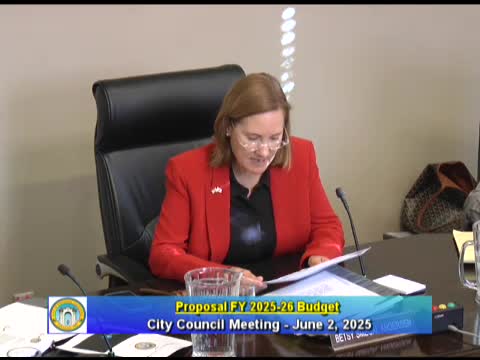
Summary
City officials presented a draft FY 2025-26 budget Tuesday that largely holds revenue flat, proposes two new full‑time positions, and would transfer $850,000 into equipment replacement; advisory committee and staff warned that the facilities capital fund will be largely spent next year and urged options to replenish it.
The Piedmont City Council held the first of two public hearings on the proposed fiscal year 2025–26 budget on June 2, 2025, reviewing revenue and spending projections, proposed personnel additions and a planned transfer of $850,000 to the equipment replacement fund. City staff and the Budget Advisory and Financial Planning Committee told council members the city’s facilities capital fund will be largely depleted under the current plan and urged finding new revenue or reprioritizing projects.
The draft budget presented by interim finance staff projects only a 1 percent increase in overall revenue for 2025–26, driven mainly by a 3 percent rise in property‑related taxes and a projected transfer tax of $4.2 million. Chuck (finance presenter) told council that, excluding pass‑through items such as ARPA and certain grants, current‑year revenue is running above budget and that the general fund ending balance for the current year is projected at about $9.8 million. "I'm going to recommend transferring $850,000 out of the general fund into our equipment replacement fund," he said, to move next year’s needed equipment funding forward.
Why it matters: The budget frames how the city will staff services and maintain infrastructure over the next year and shapes choices about large capital projects that residents raised repeatedly during the hearing. The budget also assumes full staffing for many departments and includes two proposed full‑time positions in Planning and Building; personnel costs are the largest driver of operating expense increases, staff said.
Key figures and proposals - General fund: Current‑year ending balance projected at about $9.8 million; staff proposes transferring $850,000 to the equipment replacement fund, leaving the general fund just under $9 million. - Revenue: Overall revenue up roughly 1 percent for 2025–26; property‑related taxes are projected to rise 3 percent and transfer tax is budgeted at $4.2 million (the city’s 10‑year average, staff said). Mutual‑aid wildfire reimbursements are volatile and were $300,000 this year but are not budgeted going forward. - Personnel: Personnel costs make up roughly 63 percent of expenditures. The budget assumes full staffing and two new full‑time positions in Planning and Building (assumed hired midyear). Salaries budgeted at about $17 million; health insurance and retirement costs are projected to rise substantially (staff cited a 15 percent increase in retirement costs tied to CalPERS contributions). - Pension obligations: The city’s pension rate stabilization fund (established in prior years) currently holds about $5.0 million, staff said, but projected CalPERS unfunded actuarial liability (UAL) payments and normal‑cost increases mean the fund will likely be drawn on starting in 2026–27 and could be depleted in several years if current projections hold. - Capital and facilities: Facilities capital is planned to fund large projects next year including pool completion, dispatch center relocation and phased planning for Civic Center and an essential services building. The Budget Advisory Committee and staff warned those commitments would leave the facilities capital fund substantially reduced by the end of 2025–26 and that the city should consider new revenue sources or reprioritization. - Streets and paving: Street‑related funds show carryover but pavement condition index (PCI) has declined in recent years; the public works director told council the city is roughly $800,000 per year short of the funding level needed to return the citywide PCI to the low‑70s (the range that supports the most cost‑effective preventative treatments).
Discussion and committee view Frank Ryan, chair of the Budget Advisory and Financial Planning Committee, told the council the committee found the budget “appropriately conservative” but repeated its concern that the facilities capital fund will be stressed by planned work. "It looks like there is more stress coming down the line for the city," Ryan said, urging council to plan for major facility needs that may require debt or new revenue.
City staff walked through fund‑by‑fund details: equipment replacement purchases planned next year include an audiovisual/control upgrade ($600k+), CCTV van ($350k) and IT and door‑access upgrades. Sewer fund work includes Phase 6 preliminary design and a planned $950,000 project to replace truss pipes.
Public comment and related operational questions During the hearing council heard public comments tied to safety and capital priorities. Three residents asked the council to consider adding a crossing guard at the Wildwood–Requa intersection near Wildwood School. Resident Nellie Thornton told council: "I would love for you all to consider this as you think about the budget, going forward," and cited daily school‑drop‑off congestion and U‑turns at the site. Police Chief Jeremy Bowers and staff said the vendor that provides crossing guards can assess a single location and that in past cases the vendor has provided such assessments at little or no additional cost; city staff said the city could pursue a targeted site review and then discuss cost‑sharing with the school district and possible contract amendments if council directs staff to do so.
Council discussion and next steps Council members emphasized the facilities capital shortfall and the long‑term reserve trend in the 10‑year projection; several members signaled support for placing the municipal services special tax (Measure F) and the municipal sewer tax on the ballot as part of the city’s revenue strategy. Chair Ryan and staff recommended exploring options — including preserving a ballot option and evaluating the transfer tax — and asked staff to bring a backwards timetable for any ballot measure so council can decide by the required deadlines.
The budget presentation and committee letter will return to council for a second public hearing and possible action on June 19, 2025. No final appropriations were adopted Tuesday; staff will prepare adjustments requested by council and further information on potential funding options for facilities capital and streets.
Ending Council approved a short consent calendar earlier in the meeting (minutes and acceptance of improvements for the Piedmont Park pedestrian bridge replacement), then devoted most of the session to the budget hearing and related public comment. Staff and the Budget Advisory Committee reiterated that the proposed spending plan is cautious but that the city should identify sustainable funding options for facilities capital and street maintenance to avoid larger costs later.